PTZ functions in security cameras: basics and applications
Jul 17, 2025

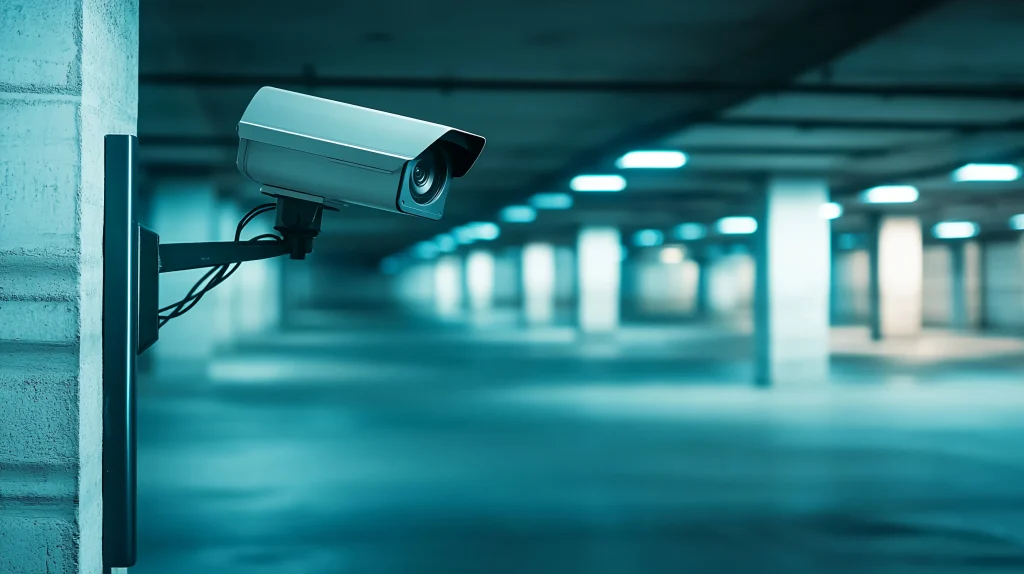
Security cameras with PTZ (pan-tilt-zoom) functions provide flexible monitoring over a wide area, which conventional fixed cameras cannot. This article gives a comprehensive explanation of PTZ, from the basics and structure to the main functions and the latest trends in integration with AI and the cloud. It explains the role PTZ cameras play in security systems and provides information to help you decide whether to adopt them.
Chapter 1. Introduction
Security measures are becoming more and more important for both individuals and businesses. Security cameras are one of the most common and effective measures and are used in many places. In recent years, in addition to conventional fixed cameras, movable, high-performance “PTZ cameras” have been attracting attention. This article explains the basic functions and mechanisms of PTZ cameras, examples of actual use, points to consider when adopting them, and the outlook for the future.
Chapter 2. What is PTZ?
PTZ stands for Pan, Tilt, and Zoom. Each term refers to the following function.
- Pan: Rotates the camera horizontally. It can cover a wide area.
- Tilt: Moves the camera up and down vertically. It can monitor areas at different heights.
- Zoom: Enlarges or reduces the view of a subject to capture detailed video. There are two types of zoom: optical zoom and digital zoom.
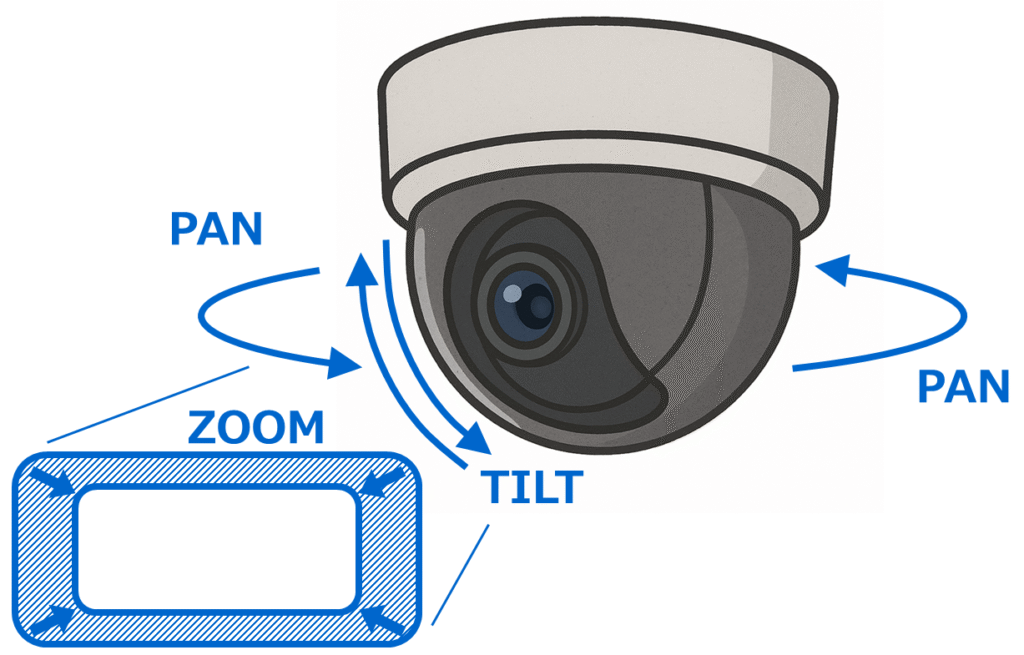
By combining these functions, a PTZ camera monitors more flexibly than a fixed camera. A single camera can track moving subjects and monitor a wide area.
Chapter 3. How PTZ cameras work and how they are built
PTZ cameras are controlled by complex mechanical structures and advanced software. The main components are described below.
- Hardware: Pan and tilt motors, a zoom lens, rotating shafts, the camera body, and so on.
- Control methods:
- Manual operation: An operator controls the camera by hand.
- Auto mode: The camera moves automatically according to a set pattern.
- Remote control: The camera can be operated from a PC or smartphone over a network.
- Communication methods:
- RS-485: A serial communication method for analog cameras.
- IP control: A network control method for digital cameras that allows more advanced control. ONVIF is the protocol generally used for control. (In ONVIF, PTZ control is defined in Profile S.)
Note: For more on ONVIF, see this article: https://amnimo.com/products/column/005/
Chapter 4. Main PTZ functions and performance indicators
PTZ cameras have a wide range of functions, so you need to choose based on your purpose.
- Presets: Store specific views and move the camera to a stored position with one click.
- Patrol: Automatically cycle through multiple preset points at set intervals.
- Auto-tracking: Automatically follow moving people or objects using AI or image analysis.
- Types of zoom:
- Optical zoom: Physical magnification by the lens. Enlarges the image without losing quality.
- Digital zoom: Magnification by image processing. Image quality may degrade.
- Other indicators: Resolution (Full HD, 4K, etc.), field of view, rotation speed, infrared illumination (for night shooting), and more.
Chapter 5. Examples of actual use and results
PTZ cameras are used at many kinds of sites and can be operated to suit each application.
- Commercial facilities: Monitoring stores for suspicious people and shoplifting. In large malls, one camera can cover a wide area.
- Factories and offices: Managing entrances and exits and monitoring work areas.
- Condominiums and houses: Keeping common areas safe and monitoring the whole property.
- Public facilities: Monitoring crowds and traffic at stations and intersections. Also useful for checking the situation in an emergency.
In these places, the flexibility and precise tracking of PTZ cameras contribute greatly to deterring crime and handling incidents.
Chapter 6. Points to consider when adopting PTZ cameras
When adopting PTZ cameras, keep the following points in mind.
- Choosing the installation location: Mounting the camera high to reduce blind spots and designing the coverage area are important.
- Ease of use: An interface users can operate easily, and whether smartphone integration is available.
- System integration: Compatibility with other security systems such as recorders (NVRs) and sensors.
- Durability and maintenance: Dust and water resistance (such as IP66), temperature tolerance, and ease of cleaning.
- Privacy and regulations: Make sure the camera’s field of view does not violate the privacy of third parties, and operate it in line with the Act on the Protection of Personal Information.
These advances are a major step toward smarter, more efficient video surveillance.
Chapter 7. Latest trends and outlook for PTZ cameras
As technology evolves, PTZ cameras are seeing advances such as the following.
- AI integration: AI technologies such as face recognition and abnormal behavior detection enable automatic judgment and response.
- Cloud support: Cloud recording and remote monitoring make operation more flexible.
- Edge processing: Real-time processing inside the camera reduces the network load and enables immediate response.
- 360-degree camera integration: Hybrid models that combine a PTZ camera with a fisheye lens have also appeared.
These advances are a major step toward smarter, more efficient video surveillance.
Chapter 8. Remote PTZ control in amnimo’s cloud video services
amnimo offers cloud video services that bring together video from security cameras spread across many sites in the cloud, so you can retrieve video and control cameras remotely. This chapter explains how remote PTZ control is implemented in these services.
- Enhanced Video Management System: The Enhanced Video Management System links the VMS running on an amnimo gateway device on site with a cloud application, so you can operate security cameras remotely with little data traffic. Remote PTZ control works in a mode called “Direct Mode,” which sets up a peer-to-peer (P2P) control path between the on-site gateway and the user’s PC. In this mode, the remote PC controls the PTZ functions implemented in the VMS.
See the Enhanced Video Management System page for details.
- Cloud Video Recorder: With the Cloud Video Recorder, a bridge device installed on site gets video from the cameras and sends it to the cloud, which stores recordings around the clock in cloud storage. When the user operates the camera from a PC browser, the cloud sends control signals to the bridge device, which controls PTZ.
See the Cloud Video Recorder page (Japanese) for details.
Chapter 9. Summary
PTZ cameras excel at monitoring wide areas and tracking moving objects, which conventional fixed cameras cannot fully handle. Adopting them requires considering cost and operation, but their flexibility and performance greatly improve the quality of security and monitoring. PTZ cameras are expected to evolve further through integration with AI and the cloud. They are well worth considering as one of your security camera options.
Products related to this article


Contact usProduct inquiries and documents
We can help you choose products and put together a package for your application. Consultations are free.