How to build a bear detection system with fewer false detections
Feb 2, 2026

Chapter 1. Introduction
In recent years, wildlife has had a growing impact on human society. Bear sightings in particular pose a direct threat to the safety and property of people in residential and rural areas. Conventional surveillance cameras and alarm systems have had problems with bear detection accuracy and operating costs. Against this background, bear detection systems that use AI technology are being developed.
Because there is no telling when a bear will appear, AI monitoring needs to run continuously. When monitoring many locations, however, keeping costs down is also an important issue. And frequent false detections increase the burden on monitoring staff, so detection needs to be accurate with few false detections. There is an urgent need to solve these issues at the same time and build a practical system.
This article introduces a solution that combines edge AI with generative AI (a large language model, or LLM) running in the cloud to reduce false detections without raising costs.
Chapter 2. System configuration
2-1. Overview of the system
This system combines several technologies to detect bears accurately and efficiently.
First, surveillance cameras installed in residential and rural areas capture video, and an edge AI device performs first-stage object detection. Because edge AI is limited by power consumption, heat, and other constraints, it performs only simple detection. When it detects a specific animal or object such as a bear, it sends a snapshot image or a short video clip to a video system running in the cloud.
The video system forwards the video data to a cloud AI (generative AI) for more accurate analysis. The cloud AI determines whether the video detected at the edge really shows a bear. It filters out events judged to be false detections and notifies users only when a bear is actually detected.
2-2. Example implementation of a bear detection system with amnimo products and services
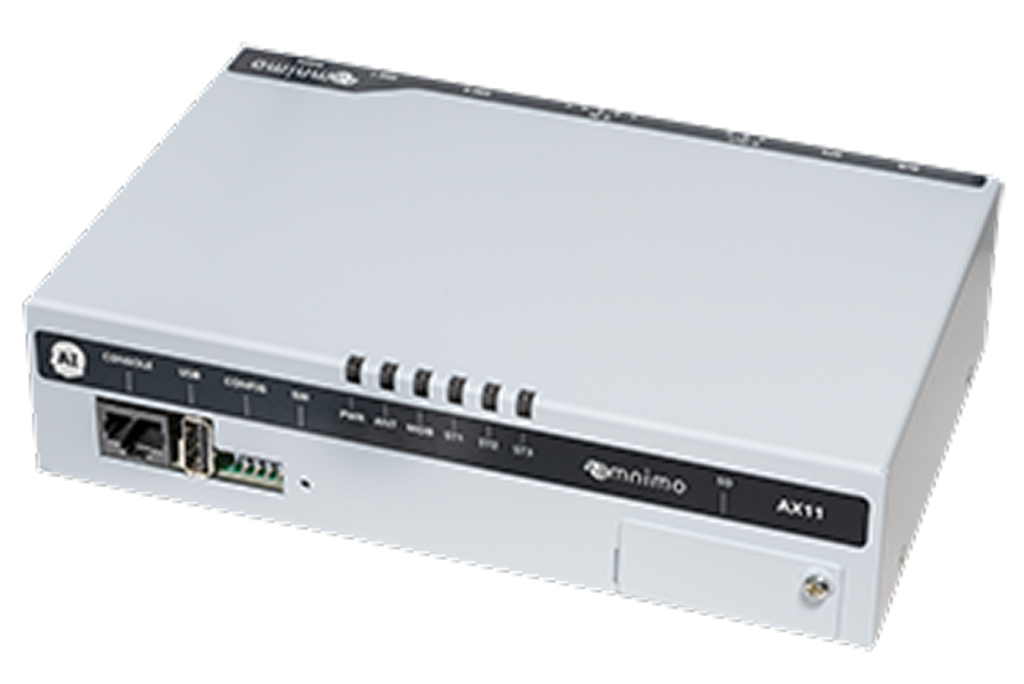
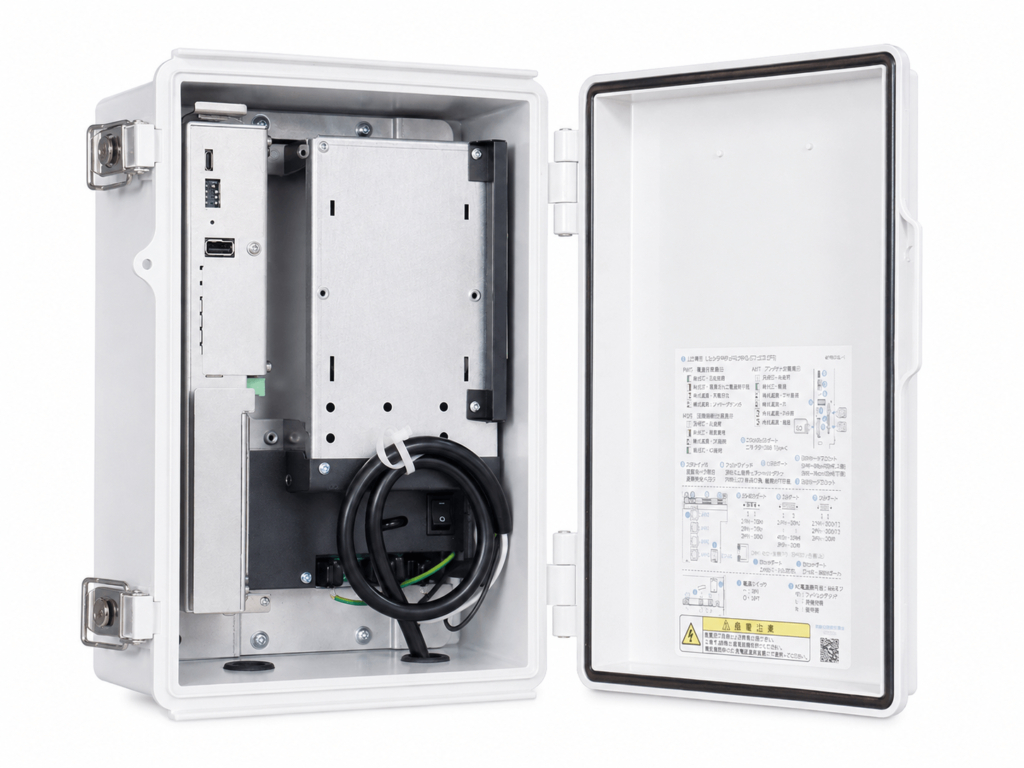
A bear detection system with this configuration can be built by combining products and services amnimo already sells with the generative AI available in common cloud services such as AWS. It is based on the edge AI device, the AI Edge Gateway (Indoor) AX11, or the outdoor model, the AI Edge Gateway (Outdoor) AX21; the Enhanced Video Management System, which handles video and event information; and the Device Management System (DMS), which maintains and operates devices and controls digital output (DO) ports. Simple integration logic is implemented on the edge and cloud sides to link with the generative AI available on AWS or similar services.
In this configuration, the edge AI performs object detection on camera images. When it detects a bear, it sends an event notification and video to the Enhanced Video Management System. The Enhanced Video Management System asks the generative AI to reanalyze the video and check whether a bear is captured or it is a false detection. If a bear is judged to be captured, the system sends an alert signal to the operator and turns on a warning light on site through the Device Management System.

Figure 1: Example configuration of a bear detection system
Chapter 3. Role and technical features of the edge AI (AX11)
3-1. Overview of the object detection model
The edge AI device (AX11) analyzes video from surveillance cameras in real time and detects the movement of specific animals, such as bears, and objects. The object detection model uses AI image recognition to pick out targets from feature points and movement in the video.
3-2. Constraints such as power consumption and heat
Because edge AI is installed on site, it faces strict constraints on power consumption, heat, installation space, and environmental durability. The AX11 uses a low-power chip as its AI accelerator, generates less heat than other models, and also supports outdoor installation. However, its AI processing capacity is limited, and improving accuracy at each installation site requires retraining with many images. Making this device alone more accurate is therefore not cost-effective.
3-3. Why low-accuracy detection is used, and its benefits
Edge AI lacks the computing resources for high-accuracy analysis, and retraining takes enormous cost and time, so it is limited to first-stage, low-accuracy detection. This, however, keeps the frequency of sending video to the cloud AI low and reduces communication costs and cloud analysis fees. Detailed analysis runs in the cloud only when the edge detects “movement that looks like a bear.”
Chapter 4. High-accuracy analysis and control by cloud AI (generative AI)
4-1. Technical overview of generative AI
The cloud AI analyzes the video data sent from the edge AI with high accuracy. Generative AI uses deep learning to identify animal species and behavior patterns in the video. This lets it judge with high accuracy whether a bear is really in the picture and whether the situation is dangerous.
4-2. How high-accuracy judgment works
Based on the first-stage detection by the edge AI, the cloud AI combines multiple analysis models to make a final judgment. For example, it evaluates a bear’s characteristic movements and body shape together with information about the surrounding environment to prevent false detections. Users are notified of the result and prompted to respond on site if needed.
Chapter 5. Role of the Enhanced Video Management System and the Device Management System
5-1. Passing and managing video data
The Enhanced Video Management System receives snapshot images and video clips sent with edge AI detection events and forwards them to the cloud AI. It also provides video to the cloud AI and AI agents, for example by retrieving video recorded on the edge device when the cloud AI requests it.
5-2. Control and operation monitoring by the Device Management System
The Device Management System controls on-site devices at the request of AI agents, for example by turning on a warning light or sounding a buzzer or siren. It also manages edge AI devices, cameras, and peripherals from one place, detects failures through device health monitoring, and changes settings or sends control commands as needed.
Chapter 6. Benefits of this approach
6-1 Benefits for detection accuracy
In this approach, the edge AI uses high detection sensitivity (it raises detection events even when confidence is low), and the generative AI rechecks them to reduce false detections and keep accuracy high. The result is a system with few missed detections and few false detections.
6-2 Benefits for the operating cost of continuous analysis
The edge AI runs on the AI accelerator in the on-site device, so its cost is fixed even when it runs continuously. The cloud AI (generative AI) charges per process, but because the edge AI filters the video, the cloud AI analyzes only video that looks like a bear. This cuts costs significantly compared with continuously analyzing all video. As a result, continuous analysis becomes realistic even in areas where bears are expected to appear, which makes the system more practical.
Chapter 7. Outlook and challenges
Bears are generally active during the day, but in recent years there have been more cases of bears appearing in the evening and at night. Some recent mass-market surveillance cameras can shoot with high sensitivity even in the dark. In places with street lights, such as residential areas, these cameras should provide sufficient video. In places with no lighting at all, such as mountain areas, thermal cameras would be used. In that case, both the edge AI and the generative AI need to handle thermal video, and suitable AI may not yet be available. Field trials are important for choosing the most suitable camera for each installation site.
Chapter 8. Summary
Damage caused by bears affects people’s daily lives, and measures are needed soon. This article introduced an example configuration of a bear detection system that combines edge AI with generative AI running in the cloud, with few missed detections and few false detections. Because this configuration combines existing technologies, we believe it can be built for field trials without large-scale development. Bear countermeasures are expected to be considered in more and more places, and we hope this system will help.
If you are interested in the systems and services in this article, contact us using the form below.
Products related to this article

Contact usProduct inquiries and documents
We can help you choose products and put together a package for your application. Consultations are free.