Major challenges in the security services industry and how to solve them
Jul 14, 2023

The security services industry faces serious challenges, starting with labor shortages, partly because of its image as a tough working environment. Solving these challenges calls for technology that lets fewer people provide security. This article explains the challenges of the security services industry, focusing on AI as one way to address them.
Recommended products

Major challenges in the security services industry
Security guards are essential for keeping people safe in many places, such as construction sites and public facilities. With large events being held more often again after the COVID-19 pandemic, demand for security guards is rising.
However, while demand in the industry is growing, few people are looking for these jobs, and the industry faces many serious challenges, starting with labor shortages.
The five main challenges in the security services industry are as follows.
Chronic labor shortages
The first challenge is a chronic labor shortage.
According to the Ministry of Health, Labour and Welfare (MHLW) report on general employment placement for March 2023 and FY2022, the ratio of job openings to applicants for “security” occupations, which include security guards, was 6.58. Compared with 1.22 for all occupations, this shows a severe shortage of workers.
Source: MHLW, “General employment placement status (March 2023 and FY2022)”
One reason for the shortage is the image that the work is physically demanding manual labor in a poor working environment. Other factors that keep new applicants away are frequent night work, which makes daily routines irregular, and the fact that guards sometimes work at dangerous sites.
Because of the shortage, training programs are not well organized, and new hires are slow to develop.
The aging of security guards has also become a challenge in recent years, and the industry needs measures focused on solving the labor shortage.
Not enough time for training
The second challenge is a lack of time for training.
As mentioned above, the labor shortage in the security services industry is getting worse. Even so, regardless of whether a worker is part-time or on a fixed-term contract, the Security Services Act requires security guard training (training for new and current guards), so new staff cannot be sent to sites right away. Specifically, new guards with no experience need at least 20 hours of training, and current guards need at least 10 hours every fiscal year. The training must also be given by a person with a national qualification called security guard instruction and training manager, so in some cases training cannot be carried out smoothly because there are not enough qualified people.
Against this background, the rules under the Security Services Act were partly revised in 2019, shortening the training hours for new and current guards (for example, new guards previously needed a total of 30 hours of training).
However, in an industry with a chronic labor shortage, shorter training hours under the revised rules have not solved the underlying problem.
Complex labor management
The third challenge is labor management.
In the security services industry, pay differs by employment type and rank, and pay timing often varies, such as monthly or daily pay, so labor management tends to be complicated. Many offices still handle guards’ personal information and shift management on paper, and digital transformation (DX) has been put off.
The larger the security company, the more guards and contracted sites it has, so the volume of labor management work becomes enormous.
Aging security guards
The fourth challenge is the aging of security guards.
Japan as a whole is concerned about a shrinking workforce due to its low birth rate and aging population, and in the security services industry, the share of employees aged 60 or older is very high, at about 30%* (compared with an average of about 10% in other industries). As described later, young people avoid the industry because of its image as a poor working environment, and job postings attract only older people. This is one reason the workforce is aging. Security work involves a lot of standing and moving around, which is physically demanding, and tasks such as approaching suspicious persons cause high mental stress, so there are concerns about health risks for older workers.
Companies also need to take steps to support the employment of older workers, such as assignments without night shifts and transfers to other work locations, with their stamina and health in mind.
Working environment
The fifth challenge is the working environment.
Because of shift schedules, security work often involves night shifts and work on weekends and public holidays. Daily routines tend to be more irregular than those of typical office workers, so the image of a poor working environment is deeply rooted. Although there are breaks, guards are often on duty for 8 hours or more, and long hours of standing and work at dangerous sites are not unusual.
Some sites involve guarding expensive items, which adds mental pressure. Some sites and companies have relatively good working environments, but the overall image is so negative that few people enter the industry, which tends to create a vicious circle that makes the working environment even worse.
The next section explains specifically how to address these five challenges.
How to solve the challenges of the security services industry
To solve the industry’s challenges, companies need to make work easier, for example by hiring more people and reviewing the work environment and employment systems. In addition, solutions that reduce the number of people needed, such as automated security systems and surveillance and security cameras, are also effective. The use of AI in security is expected to grow, and some cases have already appeared where AI takes over work previously done by guards.
Each of these is described in detail below.
Make job postings more visible
The security services industry has a high turnover rate on top of its chronic labor shortage, so companies must keep hiring. They need to make job postings more visible, for example through online job listings and job advertising. However, they must be aware that more visible postings may still attract only older applicants.
Review the work environment and employment systems
Low retention and labor shortages in the industry are caused by inadequate pay and benefits and by concerns about physical demands. Worries about whether one can keep working long term with little pay growth and in a physically hard environment are a barrier to hiring, so better employee benefits are one way to address the challenge.
However, improving benefits and employment conditions raises labor costs, which may become a burden for the company.
Use automated security systems, surveillance cameras, robots, and AI
The solutions above rely on more people or small improvements, so they do not solve the underlying problem.
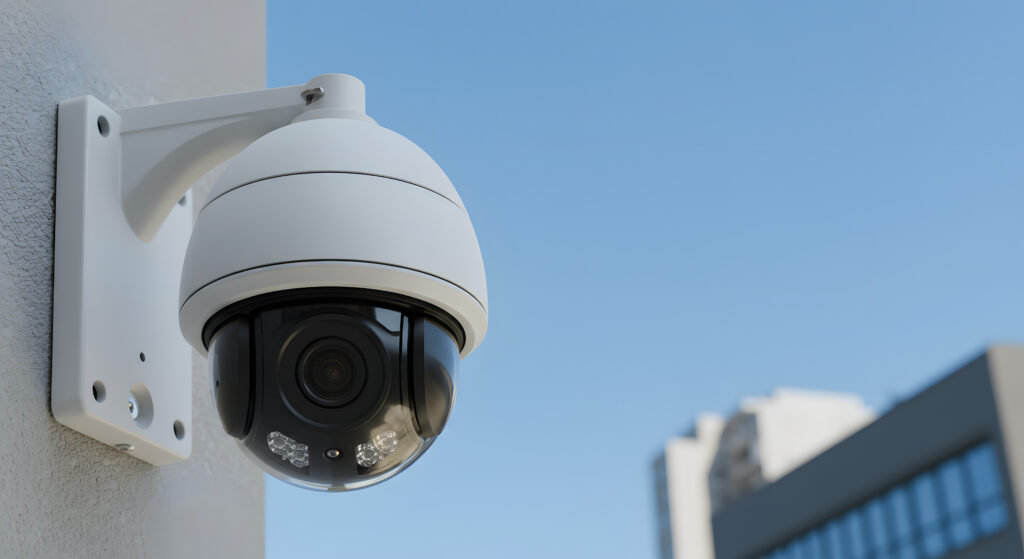
This is where reducing the number of people needed with automated security systems, surveillance cameras, robots, and AI is effective. For example, by replacing patrols previously done by guards with “automated patrols” by security cameras or self-driving security robots, fewer people can cover multiple sites. Another effective option is an automated security system that uses surveillance cameras with sensors to report abnormalities on site automatically.
In recent years, the use of AI has also attracted attention.
AI can be used in security in many ways. Robots and drones with AI can take over patrols that people used to do. AI can also be built into security systems to take over work such as monitoring and analyzing what surveillance cameras capture.
We have touched on the use of automated security systems, surveillance cameras, robots, and AI in the security services industry. The next section explains the benefits and effects you can expect in practice.
Benefits of AI-based security
Using AI in security work not only helps solve labor shortages but also brings the following two benefits.
Better security
The first benefit is better security.
AI-based security can effectively monitor areas that were hard for the human eye to see, without the possibility of human error, so you can expect better security. AI can also provide accurate, real-time monitoring around the clock, which is hard to do with people because of physical limits and labor costs.
Predicting crimes and accidents
The second benefit is the prediction of crimes and accidents.
By analyzing past crimes and accidents and the behavior patterns of suspicious persons, AI can also predict crimes and accidents in advance. The accuracy of this analysis and prediction is improving rapidly, and AI is becoming able to make detailed and accurate judgments even about small irregularities.
Examples of AI-based security
AI-based security is already being introduced at many kinds of facilities.
At one commercial facility, staff monitored and managed several hundred surveillance cameras by hand. The workload was heavy, and incidents and accidents were sometimes missed.
The facility introduced an AI security system in which artificial intelligence (AI) detects abnormal and suspicious behavior in video from many cameras, 24 hours a day. AI classifies the detected behavior and automatically notifies managers with alerts, making monitoring work more efficient.
Points to consider for AI-based security
There are also points to keep in mind with AI-based security. Specifically, there are two.
Point 1: Don’t rely entirely on AI; plan for people and AI to work together
As we have seen, AI can take over security work that people used to do. However, AI has its limits, and robots with AI may be damaged or stolen.
Even as AI improves, there will still be situations where people must solve problems, such as dealing with suspicious persons. For this reason, it is important for the security services industry to plan for technologies such as AI and people to work together.
Point 2: Build an environment for centralized management
For AI-based security and people to work together, it is important to set up an environment where you can manage AI-equipped cameras, robots, and other equipment centrally.
Managing surveillance camera video and other data from each site centrally lets you operate many cameras and robots efficiently, and also respond quickly after an incident.
The next section introduces a solution that provides this kind of centralized monitoring and management and addresses the challenges of the security services industry.
amnimo solutions for the challenges of the security services industry
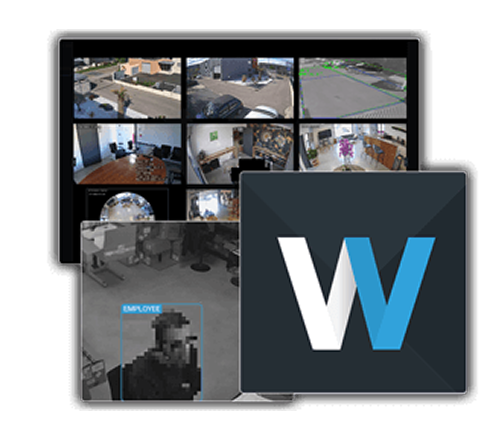
amnimo Inc. provides the Enhanced Video Management System, an application service for managing surveillance cameras spread across many sites in a unified way. Through alert integration, you can retrieve important surveillance camera video linked to an alert from a remote location on a PC or other device, so you can manage many sites centrally and make security work more efficient.
amnimo has also developed the AI Edge Gateway series, all-in-one devices that record surveillance camera video at the edge and run AI image analysis at the same time. Combined with the Enhanced Video Management System described above, they keep security operations running without interruption.
Below is an overview of the AI Edge Gateway series, including a video.
Recommended products

For more about the Enhanced Video Management System from amnimo Inc., see below.
Recommended products
For a detailed explanation of the AI Edge Gateway series or the Enhanced Video Management System, or for a consultation, contact us using the inquiry form below.
Products related to this article
Contact usProduct inquiries and documents
We can help you choose products and put together a package for your application. Consultations are free.