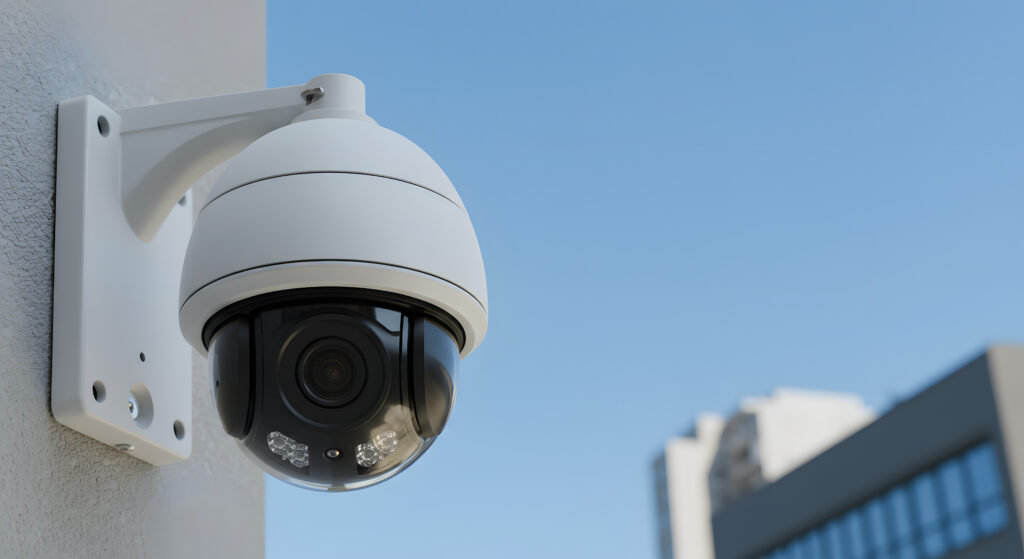
What are outdoor security cameras with no power wiring?
Mar 23, 2023

Security cameras that need no power wiring are easy to install outdoors. This article explains the types of security cameras that need no power wiring, their advantages and disadvantages, and how to choose a camera for each use case.
What is a security camera with no power wiring?
A security camera with no power wiring is one that needs no electrical work. As you know, a security camera needs power to run. When you install one outdoors in particular, electrical work to supply power to the camera is essential, and in Japan it must be done by a licensed electrician. A camera that needs no power wiring has its own power source inside, so you can install it easily, without electrical or cabling work, even where power is hard to supply. Of course, dust and water resistance is also essential. The IP code is the standard used to rate dust and water resistance. The higher the number, the better the protection.
What types of security cameras need no power wiring?
Security cameras that need no power wiring include solar-powered and battery-powered types. Let’s look at the features of each type below.
Solar-powered security cameras
Solar-powered security cameras, which run with a built-in solar panel, have recently become popular. The solar panel is installed in a sunny place and keeps charging the battery with sunlight. Even at night or on cloudy days, the camera keeps running on the power stored in the battery. The biggest advantage is that you need neither a power route nor a communication route, so installation and startup are easy. If the camera has motion detection, it records only when it detects movement in front of it, which keeps power consumption to a minimum. Models with Wi-Fi or a SIM card can send video wirelessly to the cloud so you can check it remotely. Another advantage is that they can be used almost indefinitely.
Battery-powered security cameras
Battery-powered cameras have the disadvantage that you need to replace the batteries regularly. Their main appeal, however, is that they are very low in cost. Of course, they need no cabling or power wiring, so you can install them anywhere around a house or parking lot, including places without an outlet or high places that cables cannot reach. Products with a built-in human presence sensor can automatically notify a registered smartphone and start recording when the sensor detects a suspicious person. For crime prevention, you can watch the entrance, garden, and other areas around your home 24 hours a day, whether you are out or inside. Many customers who want an easier way to install a security camera choose this type.
Advantages and disadvantages of security cameras with no power wiring
Advantages
1. Easy to install
Installing a security camera with wired power requires cabling work, including drilling holes in the structure to run power and communication cables. A camera powered by dry-cell batteries or solar charging is installed simply by fixing it to a wall or roof.
2. No need to drill holes in walls
When you install a security camera at home, you have to run cables from the distribution board, router, or recorder inside. This means drilling holes in the walls, and repairing them costs extra. A network camera that sends video over Wi-Fi or LTE needs no such work.
3. A neat installation
To install a security camera, you usually have to run cables outdoors. The cables to the camera must be covered for a clean finish. A camera that needs no power wiring is fully wireless, so no cabling is needed. A neat-looking installation is a major advantage.
4. Lower initial costs
If cabling work is needed, you have to hire a specialist contractor, which adds construction costs. Anyone can easily install a security camera that needs no power wiring.
Disadvantages
1. Batteries need regular replacement
Battery-powered cameras need their batteries replaced regularly. In standby mode, a camera typically runs for about 6 to 12 months. If video is stored on a microSD card (Japanese), you also need to replace or format the card regularly.
2. Solar-powered cameras need regular maintenance
Over time, dust, fallen leaves, and other dirt build up on outdoor solar panels and lower their power generation efficiency. You therefore need to clean the panels every few months. It is also important to install the solar panel in a place and at an angle where it gets enough sunlight. In addition, during long periods of bad weather, such as the rainy season or heavy rain, the battery can run out, and recently there have been many cases where the camera was not running at the critical moment. Regular maintenance is essential, especially when the camera is used to monitor river flooding, landslides, or avalanches.
Where can they be used?
Here are some use cases where security cameras with no power wiring are actually used. Use them as a reference when you consider installing one.
Solving neighbor disputes and vandalism at a detached house
An intercom only shows a visitor’s face. With a security camera that needs no power wiring, you can see the whole scene, including how many people there are and what they are wearing. It can also record evidence to help resolve illegal dumping or car break-ins. Installation and setup are very easy, but SD cards tend to have little capacity. Recordings are overwritten automatically if left alone, so check the card a few times a week so that you do not lose important footage.
Products with night recording or night vision (thermal cameras (Japanese)) can record in dark places. Security cameras with night recording shine infrared light so they can record in darkness, and cameras with night vision use faint light or lamps to record. To reduce blind spots, models with a wide-angle lens that covers a wide area, or models that record a full 360°, mean you do not need to buy several cameras, and you can see which direction a suspicious person came from. The coverage area differs by brand, so check the angle of view in advance.
Other options include models that record audio along with video, models with a speaker and microphone for two-way calls, models whose pan, tilt, and zoom (PTZ) can be controlled remotely, and models with built-in AI.
Recording and monitoring wildlife
Trail cameras that run on dry-cell batteries are small and easy to attach to trees and signs, so they are often used to observe and monitor wildlife outdoors. They are installed in the animals’ habitat, but you never know when or where wild animals will appear. You predict the animals’ movements and install the camera at a specific spot. If the prediction is wrong, it is very convenient that you can easily remove the camera and set it up somewhere else. The latest models can also send high-resolution footage to the cloud for remote monitoring, which makes them much easier to use. They are also installed on mountain trails to warn hikers early of dangers such as bears.
Fields, ranches, mountains, and other places where power and network work is difficult
Thefts of crops and livestock keep occurring, and more and more people use security cameras with no power wiring to address them. Running power and LAN cables across a large site is very costly, so wireless cameras that need no power wiring and are easy to install are useful. Because you do not know which part of a field thieves will target, being able to move the camera many times is another major advantage. These cameras can also be used to deal with birds and animals in fields and ranches, prevent theft of materials and trespassing, and monitor illegal dumping in mountains and vacant lots.
Recording video at construction sites
When you want to record a construction site only for a certain period, you can simply install the camera and start recording, with no electrical or network work. These cameras are well suited to checking progress at construction sites and preventing theft of construction materials.
Monitoring rivers and landslides as floods grow more severe
More and more surveillance cameras powered by solar panels are used to monitor natural disasters, such as dangerous river water levels and landslides during typhoons and torrential rain. They can be set up outdoors easily without running power or communication lines. However, the continuous operating time varies with the solar panel capacity and the severity of bad weather. There have been reports of cameras that stopped recording because their power ran out after long periods of rain or cloud.
Summary
This article explained the types of security cameras that need no power wiring, their advantages and disadvantages, and how to choose a suitable camera for each use case. These cameras are used more and more not only for home security but also in harsh outdoor environments far from towns. When you buy one, consider not only the price but also your use case, and choose a suitable security camera.
Fuel cell–powered surveillance cameras are drawing attention
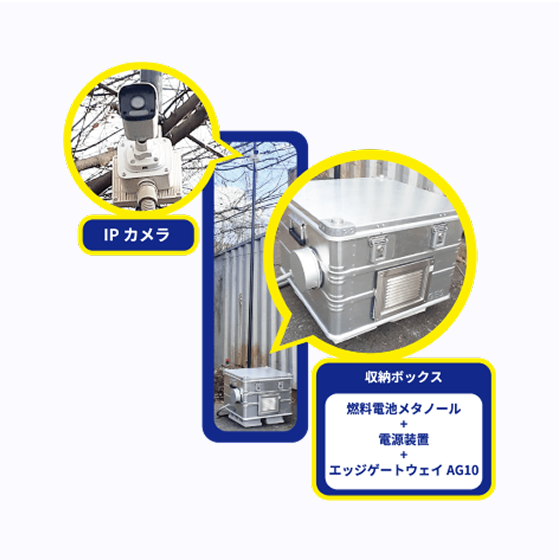
To-No Security, Inc. has released the Fuel Cell Surveillance Camera Solution, developed with technical cooperation from amnimo, which lets you check video from remote locations in real time. With a stable power supply from a fuel cell and LTE communication, it can be installed where power lines and networks are hard to run. This makes it effective for disaster preparedness, such as river monitoring and landslide monitoring.
Specifically, the fuel cell supplies stable power to an IP camera over PoE (Japanese), so you can watch live video remotely even where no power supply is available. The system uses a methanol fuel cell. With the 40-liter version, it can run continuously for up to eight months. Over a wireless LTE connection, you can check video of river water levels and landslide sites in real time from a PC, smartphone, or other device.
The system is well suited to places where power lines are hard to run, such as river monitoring, cliff collapse monitoring, avalanche monitoring, coastal security monitoring, fish farms, power facility monitoring, and non-electrified railways.
For details on the service, see the product information and brochure below.
Recommended documents

50+ related documents
Free download (Japanese)
Recommended products

Products related to this article
Contact usProduct inquiries and documents
We can help you choose products and put together a package for your application. Consultations are free.