Video infrastructure for the age of AI agents: Why amnimo’s video platform is drawing attention
Feb 5, 2026
Chapter 1. Introduction
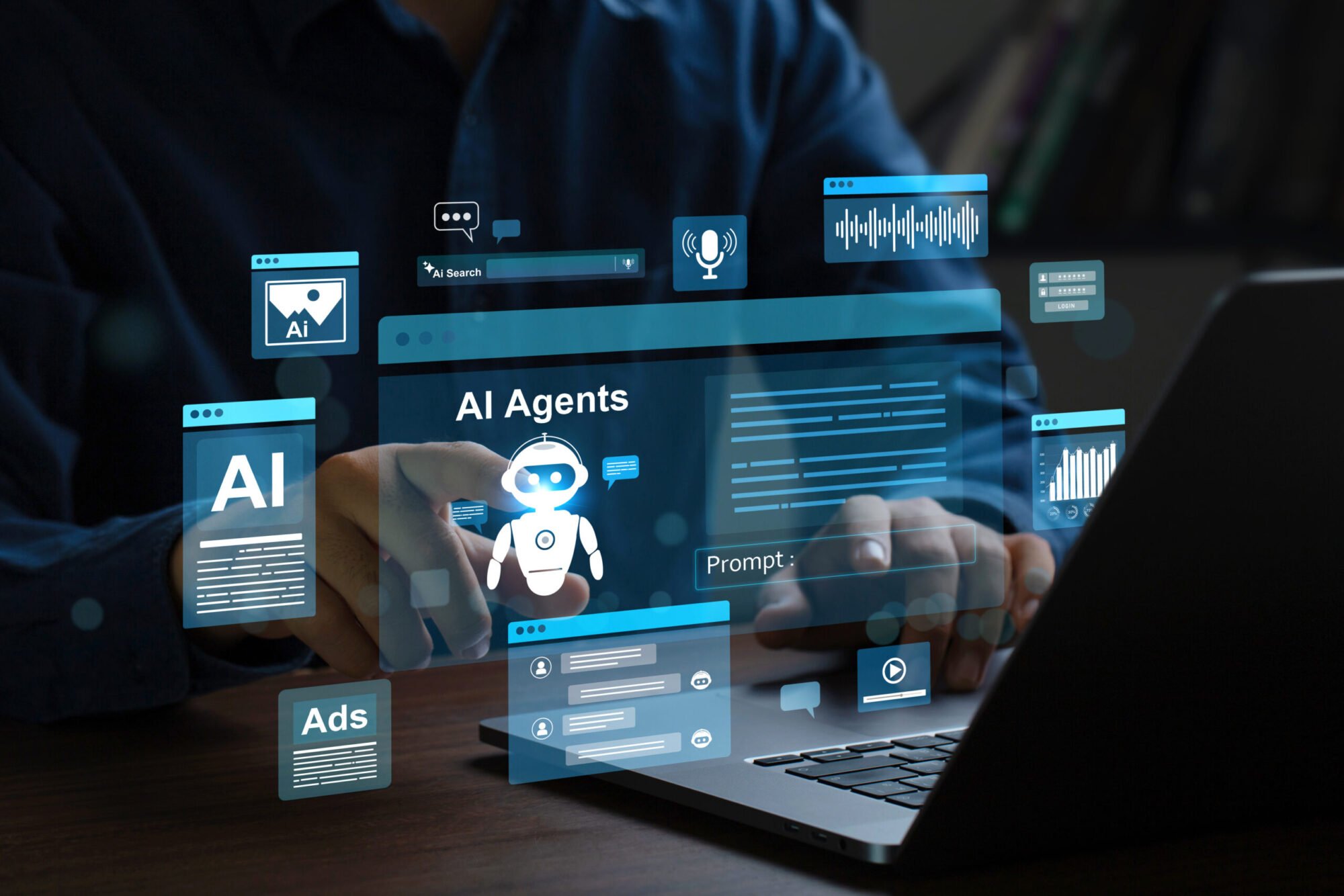
Generative AI, based on large language models (LLMs), is moving beyond generating text and images. Its focus is shifting to “AI agents” that run business operations on their own. Better multimodal capabilities are making it possible for AI to “look at video, judge the situation, and act on its own,” as people do.
This makes video platforms, which act as the “eyes” that tell AI what is happening in the real world, much more important. But installing cameras is not enough. For AI agents to perform at their full potential, they need an advanced infrastructure that can find “the video that is needed” in large amounts of data and deliver it in a form that is easy to analyze.
This article uses the services of amnimo Inc. as an example. amnimo combines surveillance camera systems with cloud technology and offers flexible expansion through API integration. We describe in detail a future in which AI agents and video surveillance systems work together.
Chapter 2. Where “video platforms” that feed video to generative AI stand today
Until now, video platforms have mainly been “recording devices for people to check later.” In today’s systems, which assume AI analysis, their role is changing.
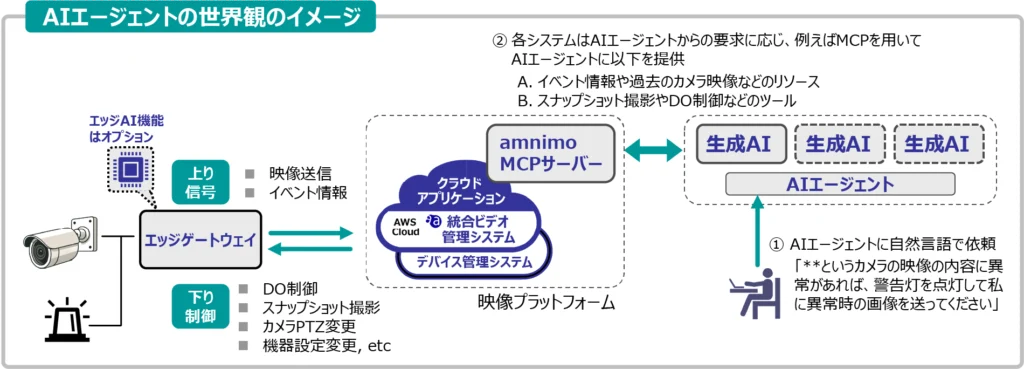
For AI agents to monitor sites in real time and detect anomalies, two things are essential: an “edge gateway” that transfers video reliably, and a “mechanism” that passes that video to the AI through the cloud.
2-1. The role of the edge gateway
A high-performance “edge gateway” is the starting point for supplying video to AI agents. It is more than a router. It plays the following key roles.
- Storing all video and extracting it on demand: The gateway records video locally on its built-in SSD. When an external system sends a request, it immediately retrieves only the part of the video that is needed.
- Efficient cloud integration: The gateway sends only the necessary video to the cloud, so it does not overload the mobile network bandwidth. It also stays ready to receive control from the cloud at all times, and can upload past recordings as needed.
- First-stage processing at the edge: Instead of sending all video to the cloud, the edge detects that “something moved,” or uses edge AI to detect specific objects or postures. Only the video with detections goes on to second-stage processing by generative AI. This keeps communication costs down while enabling advanced AI analysis.
2-2. The role of the Enhanced Video Management System
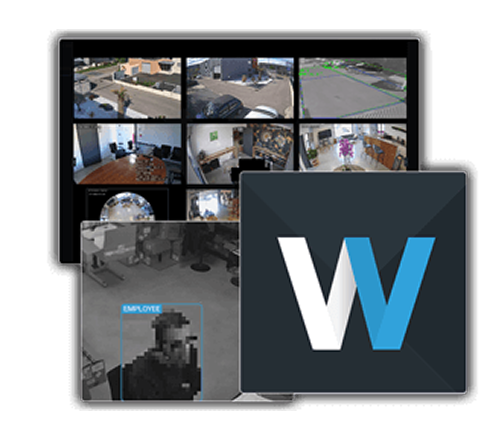
The Enhanced Video Management System lets AI agents pull video collected in the cloud “at any time, from any camera.”
amnimo’s cloud services are designed to integrate flexibly with external systems through APIs. Through a program, an AI agent can call up live video from a specific camera, or extract and analyze video from a specific past time period. This “easy access through APIs” is the key to building advanced video analysis systems.
Chapter 3. What is an AI agent?
An AI agent is an AI system that thinks for itself, uses tools, and carries out tasks on its own to achieve a given goal.
Earlier AI was “passive.” It answered questions such as “What is in this image?” An AI agent, given an instruction such as “Keep the factory safe,” runs through the following steps by itself.
- Perceive: Identifies a worker without a helmet in surveillance camera video.
- Judge: Infers that “this is a safety rule violation.”
- Act: Issues a warning over a speaker and sends a report to the manager. It also records the event in the daily report automatically.
By repeating “reasoning” and “execution” in this way, AI agents make it possible to operate with minimal human involvement.
AI agents do not have to work within a single system. Multiple generative AI systems can also work together.
For example, when a step requires deep expertise, an AI agent can pass its data to an external AI that specializes in that field, and then build the results into its own process. Each AI takes on a specialized role, such as “research,” “analysis,” or “output,” and they complement and correct each other’s output. In this way, even complex business processes that a single AI would find difficult can be completed automatically, with high accuracy and speed.
Chapter 4. A standard that connects AI and systems: MCP (Model Context Protocol)
Until now, each system needed its own custom development before an AI agent could operate it. A new protocol proposed by Anthropic and others, MCP (Model Context Protocol), standardizes this integration.
- Sharing context: AI can directly read the situation on site (the context of “what is happening now”) and immediately use it in its own decisions.
- Standardized connections: When a video platform such as amnimo’s supports MCP (or a bridge to it is built), AI models such as ChatGPT and Claude can access video data directly, without complex customization.
Chapter 5. Use cases for video platforms and AI agents
When a video platform becomes the “eyes” of an AI agent, we can expect changes such as the following.
Security for unstaffed stores and commercial facilities: The AI detects suspicious behavior, such as lingering or unusual contact. If there are signs of shoplifting, it notifies staff, automatically traces the person’s movements in past video, and compiles the results as evidence.
Remote management of critical infrastructure: At substations, dams, and similar sites, the AI scans video at regular intervals. It reads gauges and watches for water leaks and trespassing. When it finds a problem, it can on its own dispatch a drone or arrange a repair contractor.
Logistics warehouse efficiency: The AI confirms that a truck has arrived and automates guidance to the loading berth. It analyzes unloading progress in real time and revises the next delivery plan on the spot.
Chapter 6. Three challenges for practical use
1.Balancing accuracy and cost: Doing more processing in the cloud to avoid missed detections raises communication and analysis costs. The design must find the right balance between event detection at the edge and advanced analysis in the cloud.
2. Security and privacy: Video is highly sensitive information. A strong security foundation that can strictly manage AI agents’ access rights (IAM) is essential.
3.Real-time performance suited to the application: The acceptable time from an incident to its detection and notification differs by application. The system must allow response times to be designed flexibly for each application.
Chapter 7. Summary
Generative AI has evolved from chatbots into “AI agents” that recognize the real world and act in it. In this evolution, video systems that accurately convey what is happening on site matter more than ever.
amnimo’s cloud video platform provides edge recording, cloud integration, and a way to supply video to external systems through APIs. It has the potential to become “standard infrastructure” that AI agents use to take in video.
AI agents as the “brain,” surveillance cameras as the “eyes,” and the “cloud and network” that connects them. When these work as one, they can take social safety and efficiency to a new level.
Note: Learn more about the Enhanced Video Management System, amnimo’s video platform.
Products related to this article

Contact usProduct inquiries and documents
We can help you choose products and put together a package for your application. Consultations are free.