What is an IoT gateway? Overview, role, and points to compare
Mar 23, 2023

IoT (Internet of Things), which connects things to the internet, has spread rapidly in recent years and is used in many applications, from industrial to home use. IoT consists of several elements, and the IoT gateway is one of them. An IoT gateway connects things to the internet so that they can exchange data with each other.
This article gives an overview of IoT gateways and explains their role and the points to compare when introducing one.
What is an IoT gateway?
IoT, which connects things to the internet, needs several elements. Here are the three main ones.
1. Devices, such as sensors, cameras, and IT terminals, that collect data and provide feedback
2. Integration with cloud services that store and analyze data
3. IoT communication devices that exchange data between devices and the cloud over a network
Devices such as sensors attached to equipment, surveillance cameras that show conditions, and IT terminals for input and output collect all kinds of data. The data is sent to the cloud and stored through IoT communication devices connected to the network (the internet). The stored data is used as is or analyzed with AI or other tools, and the results or commands are returned. They are sent to the devices through the IoT communication devices, and the devices respond with some kind of feedback, such as displaying information or making things move.
In the past, people collected data from devices and entered it into computers by hand, and people also provided the feedback. With IoT, things are connected to the internet, so data collection and feedback happen automatically around the clock. Data comes directly from things, so huge amounts of data can be collected in real time. Analyzing this data with AI may reveal things that could not be seen before. Because data is collected over the internet, you can get data from remote locations. You can also send commands to remote devices.
IoT is already used in many things, from home products such as air conditioners, refrigerators, and audio equipment to industrial products such as cars and production equipment. The number of devices connected to the internet through IoT was said to already exceed tens of billions as of 2021, and it is expected to keep growing exponentially.
The role of an IoT gateway
Among IoT communication devices, those that process or transform data generated by devices before sending it to the cloud are generally called IoT gateways. IoT gateways are used closer to the devices when exchanging data between devices and the cloud over a network, so they are also called edge gateways.
Devices such as sensors and cameras usually cannot connect directly to the internet, so as they are, they cannot send data. Adding such functions would make devices larger and increase power consumption, making them hard to attach to things. IoT devices are also used in large numbers, so giving them all internet connection functions would raise costs. Because each would communicate separately, the amount of information on the network would become enormous, especially for large data such as images, putting a heavy load on the cloud.
IoT gateways are used to avoid this. An IoT gateway collects data obtained by devices, sorts it by destination, and sends it to the cloud. In the other direction, data and commands sent from the cloud go to devices through the IoT gateway. By relaying through an IoT gateway, devices can exchange data with the internet even without their own connection functions.
In addition to exchanging data, IoT gateways also control devices and manage their operating status. This lets devices not only collect data but also perform actions or send out information. You can operate multiple devices remotely and check that they are working correctly. IoT gateways sometimes also supply power. For example, they supply power through PoE (Power over Ethernet) (Japanese) to devices such as surveillance cameras installed where power is hard to obtain. Some IoT gateways also store data, do some processing, and return results to each device.
Like an IoT gateway, a router also connects devices to the internet. A router is a device that decides where data is sent and routes it there. IoT gateways have similar functions but also others, and in a broader sense, devices that relay networks are called gateways.
Points to compare when choosing an IoT gateway
There are several points to compare when you consider introducing an IoT gateway. Processing speed, the number of supported communication standards, the number of ports for connecting devices, and the variety of connection interfaces should be chosen to fit the environment and the system you build.
For industrial use in particular, you also need to consider points that ordinary equipment does not have. Industrial installation sites are often harsh, with high temperatures and humidity or frequent electromagnetic interference. IoT gateways should have good heat resistance, impact resistance, and electrical resistance, and moisture-resistant treatment, so high ruggedness is required. In such harsh environments, the CPU may freeze, so an IoT gateway needs to detect CPU freezes through self-diagnosis and recover on its own, for example by rebooting.
At production sites such as factories, the power supply can also suddenly become unstable and cause momentary power interruptions. Devices with an operating system that does not restart properly when power returns after being cut without a proper shutdown are not suited to industrial IoT. Choosing an IoT gateway that supports the power available at the installation site, is highly tolerant of voltage fluctuations and noise, and keeps running normally after power is restored leads to stable system operation.
Communication functions such as LTE may also go down and stop data transmission. This is a serious problem for an IoT gateway that handles urgent data, such as video from security cameras for disaster monitoring. A mechanism that quickly switches to another communication method when one goes down can overcome such outages.
Summary
IoT gateways are essential for edge computing. You need to choose functions and design them to fit the system you are developing. This lets you automate huge amounts of work that people used to do and carry out remote monitoring smoothly. When using IoT gateways industrially in particular, choosing one with industrial features is very important for stable operations. Choose equipment that suits your purpose and environment, and build a more efficient system.
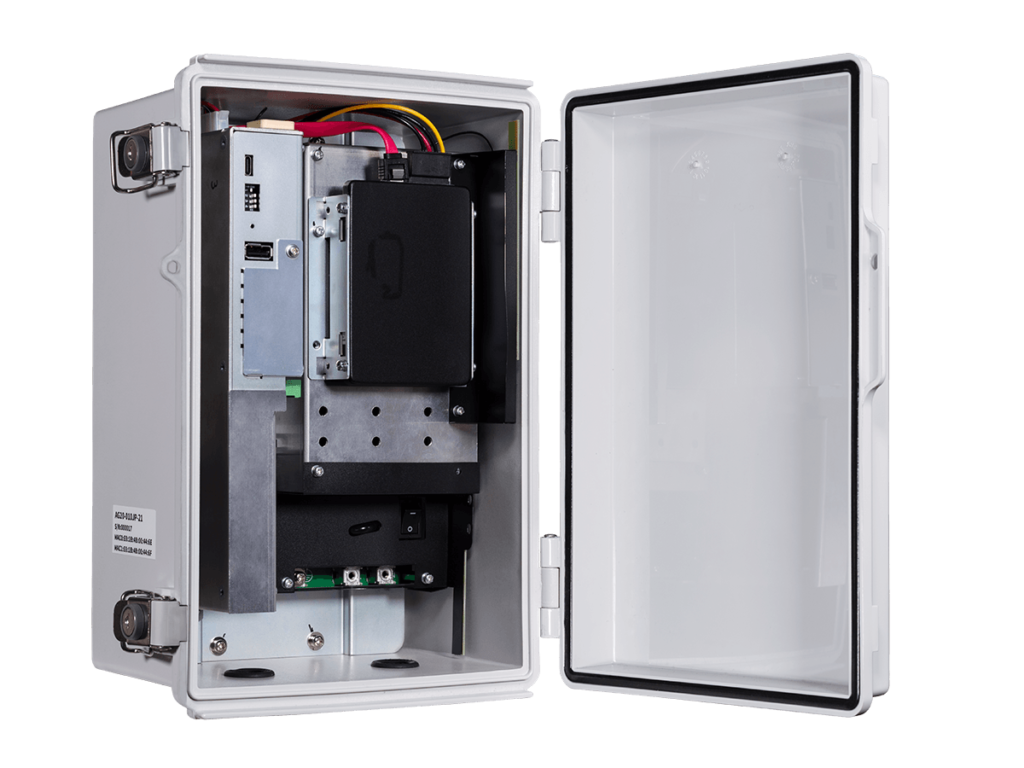
The following brochure explains the Edge Gateway (Outdoor) for industrial use in detail.
Recommended products
Contact usProduct inquiries and documents
We can help you choose products and put together a package for your application. Consultations are free.