Installing security cameras outdoors
Uses, features, and points to watch for outdoor security cameras
Mar 24, 2023

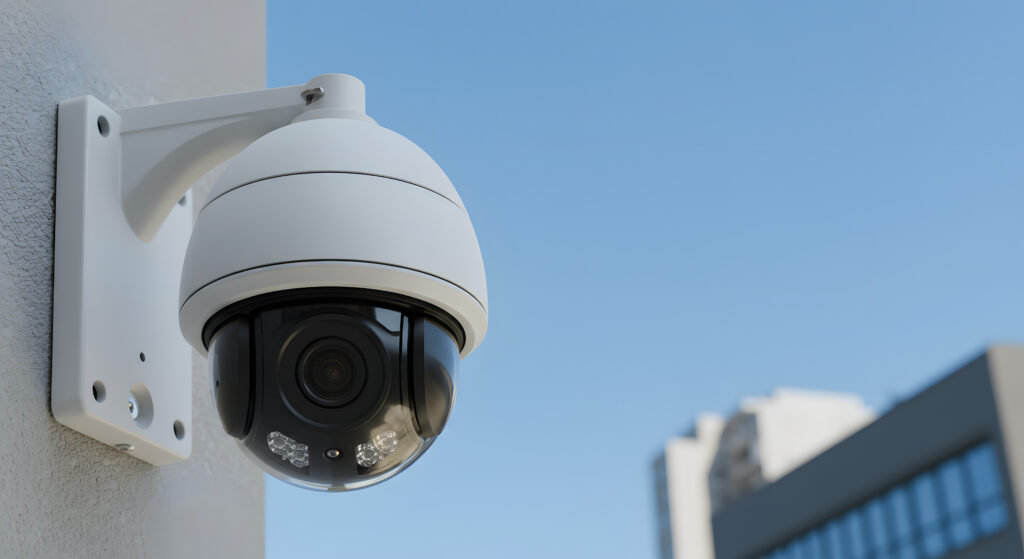
To monitor around the clock with security cameras installed outdoors, you need cameras built for outdoor use. Besides water resistance, dust resistance, and impact resistance to withstand harsh outdoor conditions, you also need to consider equipment and services other than the camera itself, such as power supply, maintenance, and communication equipment.
This article explains the uses and features of outdoor security cameras and points to watch when installing them.
Uses of outdoor security cameras
Outdoor security cameras used to be limited to special places, such as important facilities that need round-the-clock security and monitoring, 24-hour disaster monitoring systems for rivers, and monitoring systems for roads, railways, and other transportation infrastructure. In recent years, better camera performance, such as 4K and 8K, models even smaller than dome and box types, and lower prices have led to outdoor security cameras being used in many places.
Outdoor security cameras are now seen in everyday places, such as home entrances and garages, parking lots, store entrances, and utility poles in residential areas, watching over the area for crime prevention. On farms, outdoor surveillance cameras are used not only to prevent crop theft but also to check how crops are growing. At construction sites, they are used to check construction vehicles and workers coming and going. For observing wildlife behavior and for surveys in high places or natural environments that people cannot reach, trail cameras (wireless, solar-powered cameras that use sensors to detect the heat of animals or people and record automatically) are used. In the past, images from security cameras were usually viewed on monitors in a central control room, or retrieved from recorders on recorded media. Today, network cameras (IP cameras) with built-in computers are widespread, and images recorded outdoors can be checked remotely on a PC or smartphone. Recorded data can also be uploaded to the cloud and analyzed in real time. As a result, advanced camera monitoring systems that use AI to predict and report signs of disasters or crimes have been developed. Outdoor security cameras are being used more widely than ever.
Features of outdoor security cameras
Security cameras come in indoor and outdoor types. Outdoor cameras are exposed to wind, rain, and sunlight for long periods and must cope with changes between day and night, so they need different performance and functions from indoor cameras.
Water and dust resistance
Outdoor security cameras are exposed for long periods to dust blown by strong winds and heavy rain from typhoons, so dust and water protection must be considered. Joints in the camera housing and connector connections must be properly protected against water and dust.
Water and dust resistance are defined by the IEC (International Electrotechnical Commission) and JIS (Japanese Industrial Standards) as degrees of protection against the ingress of foreign objects into electrical equipment. The degree of protection is shown by “IP” (ingress protection) followed by two digits. The first digit shows the degree of protection against solid foreign objects, in seven levels from 0 to 6. The second digit shows the degree of protection against water, in nine levels from 0 to 8. IP66, for example, means dust-tight (no dust gets inside) and protected against powerful water jets from any direction.
Dust protection levels (0 to 6)
IP0X: No protection
IP1X: Protected against solid objects 50.0 mm in diameter and larger (such as hands)
IP2X: Protected against solid objects 12.5 mm in diameter and larger (such as fingers)
IP3X: Protected against solid objects 2.5 mm in diameter and larger (such as tools and wires)
IP4X: Protected against solid objects 1.0 mm in diameter and larger (such as wires)
IP5X: Dust-protected (some dust may enter but does not interfere with normal operation)
IP6X: Dust-tight (no dust enters)
Water protection levels (0 to 8)
IPX0: No protection
IPX1: Protected against dripping water
IPX2: Protected against dripping water when tilted up to 15 degrees
IPX3: Protected against spraying water
IPX4: Protected against splashing water
IPX5: Protected against water jets
IPX6: Protected against powerful water jets
IPX7: Protected against temporary immersion
IPX8: Protected against continuous submersion
Heat and impact resistance
Outdoor equipment exposed to sunlight for long periods gets very hot, especially in summer. When monitoring equipment that gives off heat or installing in places with high outside temperatures, the lens and internal circuits need high heat resistance. The camera also needs to be rugged enough to withstand unexpected impacts, such as objects blown by the wind.
Impact resistance is defined by the IEC as a degree of protection for the impact resistance of electrical equipment enclosures. The levels range from IK00 (no protection) to IK10 (withstands the impact of a 5 kg mass dropped from 40 cm).
Impact protection levels (00 to 10)
IK00: No protection
IK01: Withstands the impact of a 250 g mass dropped from 5.6 cm
IK02: Withstands the impact of a 200 g mass dropped from 10 cm
IK03: Withstands the impact of a 200 g mass dropped from 17.5 cm
IK04: Withstands the impact of a 200 g mass dropped from 25 cm
IK05: Withstands the impact of a 200 g mass dropped from 35 cm
IK06: Withstands the impact of a 500 g mass dropped from 20 cm
IK07: Withstands the impact of a 500 g mass dropped from 40 cm
IK08: Withstands the impact of a 1.7 kg mass dropped from 29.5 cm
IK09: Withstands the impact of a 5 kg mass dropped from 20 cm
IK10: Withstands the impact of a 5 kg mass dropped from 40 cm
Surge and noise protection
Outdoor equipment may be affected by lightning surges and momentary power interruptions and brief power outages (Japanese), so measures such as circuit protection and backup power are taken. Types of lightning surges include (1) direct lightning (lightning striking electrical equipment, people, or other objects directly), (2) induced lightning (damage from voltage induced by the electromagnetic field of a nearby strike), and (3) ground potential differences (damage from potential differences between grounding points caused by lightning). Installing surge protective devices (SPDs) against these protects devices from abnormal voltages such as lightning surges. An SPD diverts overcurrent that flows into a device through power or communication cables during a lightning strike and sends it to the ground.
Noise can also occur when cameras or recorders are installed near equipment that emits strong electromagnetic waves. In such cases, moving the equipment causing the noise or the camera system may solve the problem, but noise measures such as electromagnetic shielding are also used.
Night recording and image correction
Many outdoor security cameras have infrared night vision so they can record at night. With this function, they can record even in complete darkness. During the day they record normally, and at night infrared produces black-and-white video. With recent advances, some types can also record color video at night. Depending on where the camera is installed, the sun may cause backlight or strong reflected light, resulting in crushed shadows or blown-out highlights, so some types have image correction functions such as backlight compensation and noise reduction.
Wide-angle and telephoto lenses
Outdoor security cameras often record wide areas or distant places, so cameras with wide-angle or telephoto lenses are sometimes used instead of standard lenses. Wide-angle cameras have lenses of 2.8 to 12 mm. One camera can cover a wide area, so you can buy fewer cameras. Telephoto cameras have lenses of 6 to 50 mm. The coverage area is narrower, but they can capture a specific distant spot, so they are used where the subject is far away, such as monitoring river water levels or recognizing license plates.
Points to watch when installing outdoor security cameras
Outdoor security cameras are often installed in special places that are hard for people to reach or in remote locations, so there are several points to watch when installing them.
Camera location
Outdoor security cameras have noise protection and image correction functions, but it is best to install them where recording is affected as little as possible. For privacy, also avoid places where other people’s property or facilities may be captured carelessly.
When installing outdoors in particular, take care because some locations make cameras deteriorate faster. Installing them out of direct sunlight, under a roof, or where temperature changes are small can help them last longer. For durability, avoid places near equipment that emits strong radio waves, places where direct sunlight or strong reflected light enters the lens, and places near heat sources. Prioritize the area you want to monitor while choosing a location where the camera is less likely to deteriorate.
Camera installation
It costs money, but hiring a specialist contractor makes the installation safer and lets you operate it longer. Attaching a housing also helps the camera last longer. A housing is a cover attached to the top of the camera. Some products come with a housing or let you attach and remove one freely. A housing protects the camera to some extent from wind, rain, dust, and direct sunlight.
Power supply, image retrieval, and maintenance
Many surveillance cameras run continuously 24 hours a day, so power supply is a challenge. Battery-powered cameras need regular battery replacement. For cameras that record video to a built-in SD card, the flash memory used in SD cards has a write limit, so the SD card must be replaced regularly. When a camera is installed in a hard-to-reach place, such as high up, and is sealed against water, this kind of maintenance becomes very difficult.
If a control room can be set up nearby and power and video cables can be connected from there, maintenance is relatively easy. At remote sites, however, someone has to go to the control room every time and, when there is a problem, climb a ladder or otherwise reach the camera.
To make maintenance and data retrieval easier, you need measures such as connecting cameras to a network, supplying power over PoE (Japanese) through a gateway, using SSDs, and enabling remote control of the cameras.
Summary
Outdoor security cameras with higher image quality, lower prices, and smaller sizes are increasingly available, and installation is easier. More of them also support networks, making it easy to introduce remote monitoring and remote control systems. Various gateways, cloud environments, and wireless communication technologies are available for connecting cameras to networks, and operation after installation takes far less work than before. It may be worth reviewing the outdoor monitoring system you currently run.
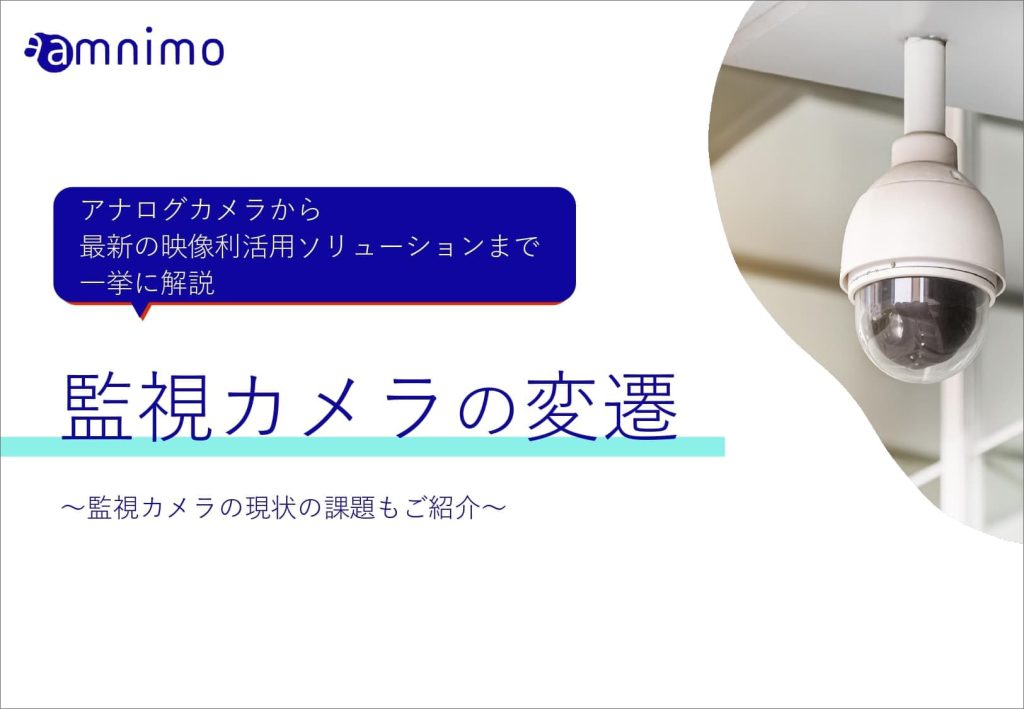
The following white paper explains the history of surveillance cameras and current challenges in detail.
Contact usProduct inquiries and documents
We can help you choose products and put together a package for your application. Consultations are free.