
Field trial report: counting visitors at a trade show booth with the amnimo Portable AB11

- Products used
- amnimo Portable AB11
Chapter 1. Introduction
The amnimo Portable AB11 is a portable camera that is easy to set up anywhere, which makes it well suited to monitoring events. As an example of how it can be applied, we ran a field trial at our own booth at a trade show, counting the number of people in front of each exhibit every minute. This report describes how we counted people and what we found.
Chapter 2. About the amnimo Portable AB11
The amnimo Portable AB11 is a battery-powered portable camera with LTE connectivity. You can install it anywhere and start monitoring right away, so it is well suited to temporary monitoring at event venues. It is rated IP67 for dust and water resistance and can be installed outdoors.

The AB11 is designed to work with a cloud service. While recording, it saves video locally and sends a thumbnail (still image) to the cloud every minute. In the cloud, you can view the thumbnails and get live video when needed. This lets you check the situation on site regularly and see the details in live video in an emergency. Later, the recorded video can be sent to the cloud over a low-cost connection such as wireless LAN, where you can watch it, cut out parts of it, and download it.
Chapter 3. Purpose of the field trial
amnimo Inc. used a trade show where it exhibited to run a field trial to test the following:
- Purpose 1: Test a way to add value to the amnimo Portable AB11, which is expected to be installed at event venues for security, by counting the number of people in specific areas of the event
- Purpose 2: Test the feasibility of using cloud AI to analyze the thumbnails that the AB11 sends to the cloud once a minute.
Chapter 4. Equipment setup for the field trial
amnimo Inc. exhibited at RISCON TOKYO 2025 (Security & Safety Trade Expo), held at Tokyo Big Sight from Oct 1 to Oct 3, 2025. We showed three products and services in a two-unit booth. To capture the area in front of each exhibit, we installed one AB11 for each exhibit on the wall about 2.5 m above the floor. Each AB11 was attached with its included clip to an L-shaped bracket mounted on the wall, and adjusted so that the lens pointed slightly downward.

An AB11 attached with an L-shaped bracket at the top of the booth

Three AB11 units installed to capture the area in front of the three exhibits
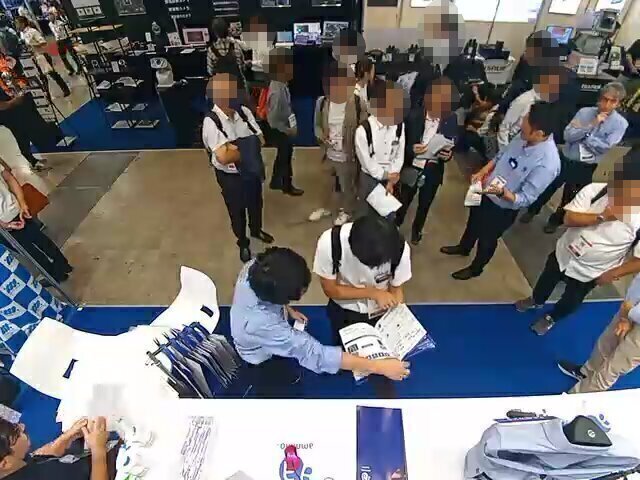
The AB11 sends a captured image to the cloud every minute, so images at one-minute intervals build up in the cloud. Below is an example of a captured image.
Chapter 5. AI analysis of the captured images
We analyzed the images stored in the cloud with the object detection function of Amazon Rekognition and counted people by detecting them. Amazon Rekognition is an AI (artificial intelligence) service from Amazon Web Services (AWS) for analyzing images and videos. It detects objects and concepts (including scenes and actions) in an image and outputs them as labels.
Note: For the object detection function of Amazon Rekognition, see:
Detecting objects and concepts – Amazon Rekognition
In this trial, we detected people in the images by processing the stored images manually in the cloud at a later date.
The image below shows the detected people.
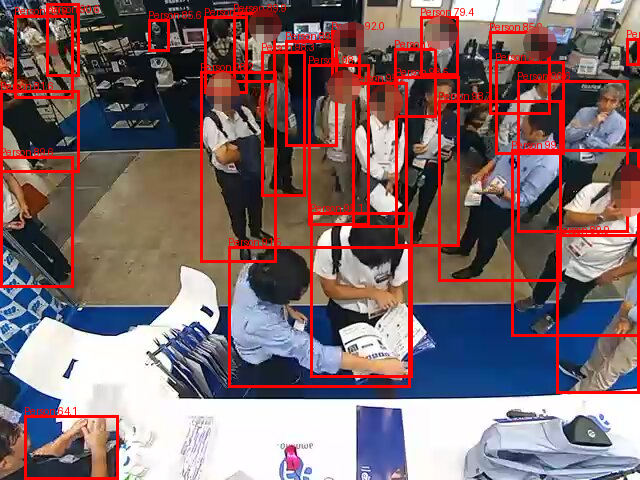
To count people, we measured the number of people detected in the frame. If the whole image were used, people walking in the aisle and visitors at the booth opposite would also be detected, so we counted only within a specific area. This let us calculate only the number of people staying in front of the exhibits.
This processing was done manually at a later date. Real-time analysis is also possible, but it requires a mechanism that sends each image to the AI and outputs the results. For this trial, we did not build that mechanism. We analyzed the images manually and graphed the resulting numbers in Excel.
Below are an image showing the detection results and graphs showing the number of people over time. To make trends easier to see, we also created graphs of five-minute averages, including two minutes before and after each point.
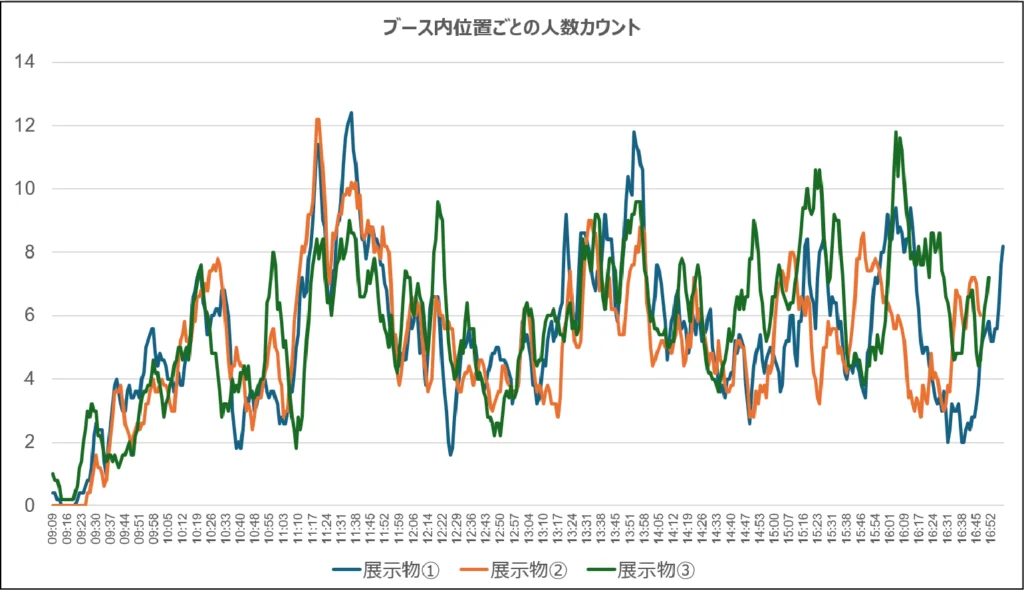
For the three exhibits, we could see which exhibit had more people in front of it at different times of day.
Chapter 6. Advantages and challenges of this counting method
This method used the functions of the AB11, which is easy to install at event venues, and analyzed images with cloud AI to count people easily and at low cost. It shows that the AB11 can be used not only for security but also to collect statistics.
On the other hand, this method only counted “the number of people present each minute.” It cannot tell how many people actually looked at an exhibit or how long they stayed. Full visitor analysis would also need this information.
In terms of cost, using standard AWS services kept the analysis very inexpensive. For example, analyzing eight hours of still images from one camera is expected to cost only a few hundred yen (JPY). A major advantage is that analyzing periodic still images, rather than continuously analyzing video, keeps the cost low.
The cameras take little effort to install and are quick to prepare, they capture images with sufficient resolution, and the analysis itself is low cost. This use case adds to the value of installing portable cameras at event venues.
Chapter 7. Summary
The amnimo Portable AB11 is a video system suited to event security. This trial confirmed that, with cloud AI, it can also be used for analysis such as people counting at low cost. Going forward, we will further consider which applications this technology suits and what value it can provide to users.
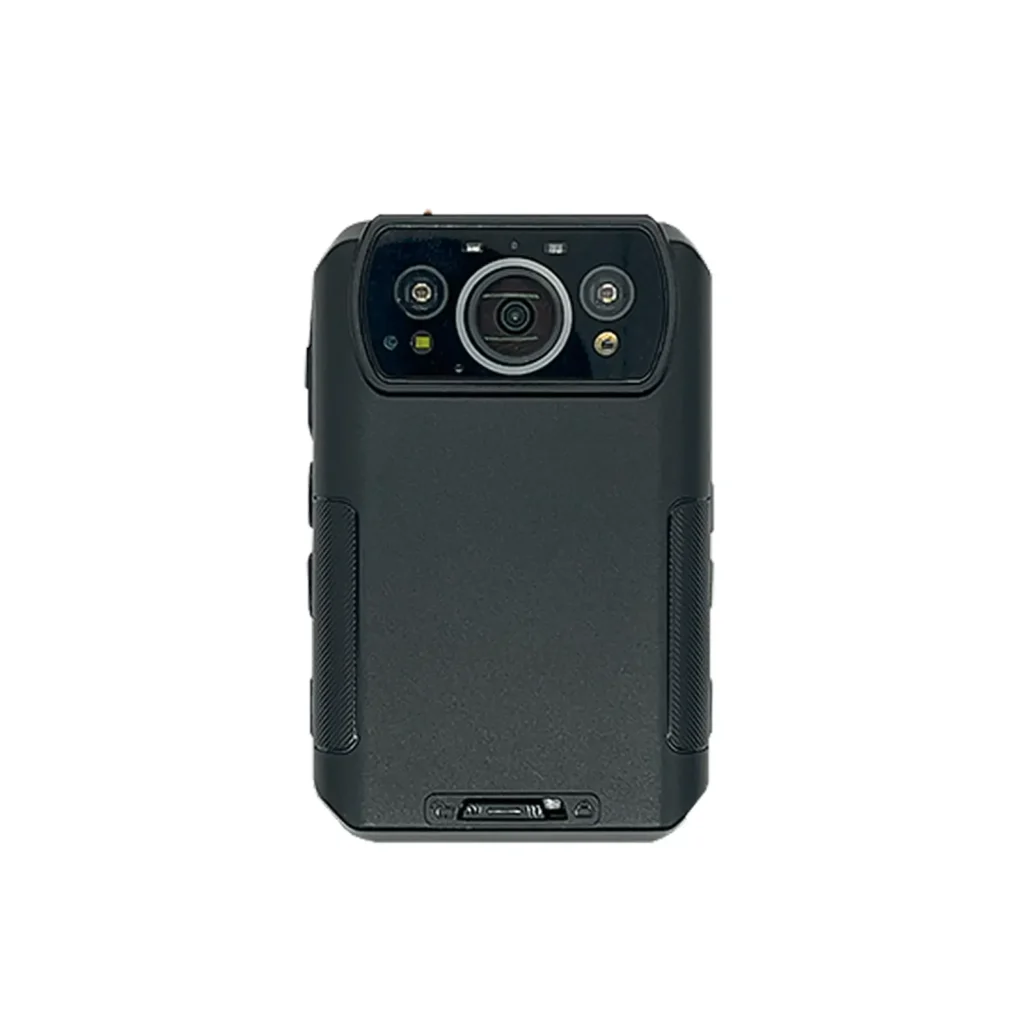
Products used in this case study
Related case studies
-
 Takaoka City: Underpass flooding monitoring solution
Road Maintenance Division, Urban Development Department, Takaoka City; TAKAOKA CABLE NETWORK CO., LTD.; and SANGIKYO CORPORATION Enhanced Video Management SystemAG20
-
 Toshima City: Disaster preparedness and crisis management camera solution
Disaster Prevention Crisis Management Section, General Affairs Department, Toshima City Enhanced Video Management SystemAG20
-
 Trial of a thermal camera intrusion detection system around an airport perimeter shows results: More efficient security and monitoring, and higher security quality
A regional airport Enhanced Video Management SystemFuel Cell Surveillance Camera Solution







Contact usProduct inquiries and documents
We can help you choose products and put together a package for your application. Consultations are free.