
Camera monitoring for wind power facilities
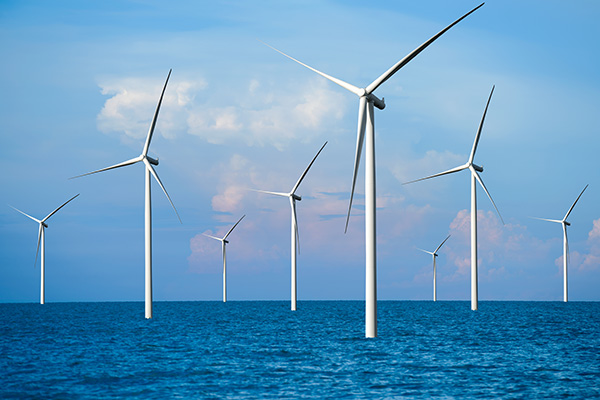
Remote monitoring of equipment for safe, reliable operation
Overview
Wind power has drawn attention in recent years as an environmentally friendly renewable energy that needs no fuel and emits no greenhouse gases. Adoption in Japan lags behind Europe and the United States, but the number of installations is growing, and about 2,500 wind turbines were reportedly installed in Japan as of the end of December 2019. However, wind power equipment in Japan tends to be stopped longer for maintenance after part failures and accidents than equipment in Europe and the United States. As a result, it runs fewer hours and its generation costs tend to be higher.

Challenge: Maintenance costs and security
Equipment at wind power facilities is prone to failures and faults from lightning strikes and aging. Maintenance costs and losses from downtime have become a problem.
1. The situation cannot be checked remotely during a failure
Equipment at wind power facilities can fail or develop faults from lightning or aging and stop running. In particular, the supervisory control system called SCADA (supervisory control and data acquisition) integrates and manages data from equipment and sensors. If SCADA stops, operators can no longer see how the rotating shaft is operating. Without knowing whether the shaft is still running normally or needs recovery work, staff must first go to the site to check. This increases maintenance costs such as site visits, and longer downtime lowers profitability.
2. Frequent failures and rising maintenance costs
Wind power equipment is precision machinery installed outdoors for long periods, so some failures are unavoidable. Lightning and similar events also often make the power supply unstable. Unexpected system shutdowns can corrupt data and increase maintenance costs. Wind power equipment is installed in remote places such as offshore or in the mountains, and maintenance must be done at great heights, so the cost of responding to failures tends to be high.
3. Unstable communication
Wind farms are often located offshore or in the mountains, where mobile signals are weak. In such locations, introducing a system that uses mobile networks has been difficult, especially one that stores data in the cloud, because of the risk of data loss.
4. Security against suspicious vessels and other threats
For offshore wind power equipment in particular, security measures such as video monitoring around the equipment day and night are needed to watch for suspicious vessels, and the system must run reliably.
amnimo’s solution: Stable operation and efficient maintenance
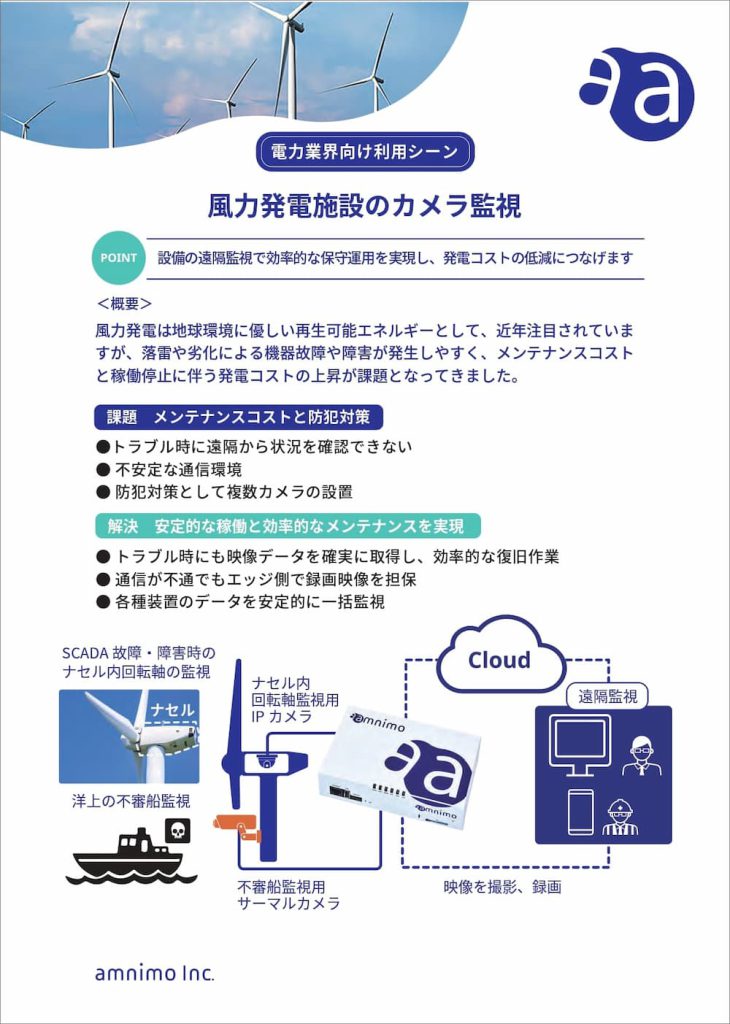
Cameras let you monitor the equipment remotely even if SCADA fails, and they also help with security.

1. Get video data during failures for efficient recovery
With a remote video monitoring system, you can check the situation even when SCADA, the supervisory control system, stops. For example, a surveillance camera can be installed in the nacelle, which houses the rotating shaft, so that video can be checked remotely. You can then confirm whether the shaft is running normally even if SCADA fails. Before sending anyone to the site, you can prioritize the response and arrange the parts and tools you need, for efficient recovery. Shortening downtime from failures, even a little, raises the facility’s operating rate and improves profitability.
2. High environmental durability for outdoor installation
amnimo products have high environmental durability that withstands outdoor use, which reduces failures and minimizes recovery work. Even if a failure does occur, automatic recovery and remote recovery work keep maintenance costs to a minimum. And even if power is lost, a large internal capacitor lets the device safely finish writing data to memory before power runs out, which prevents data corruption.
3. Recorded video is kept at the edge even when communication is down
amnimo products are designed to pick up signals reliably even where LTE signals are weak. They can also hold multiple SIM cards. If one carrier’s signal is lost, the device automatically switches to another carrier’s mobile network to work around the outage. And even if communication is cut off, data is stored on the device on site. Unlike systems that keep all data in the cloud, you do not have to worry about losing data when communication drops. When communication is restored, you can retrieve the data and video you need remotely.
4. Use cameras from multiple vendors
Watching for suspicious vessels at sea, including at night, requires cameras such as thermal cameras. You may install different cameras, such as a normal optical camera in the nacelle and a thermal camera for security. amnimo products can record and display video from cameras of different types and vendors in one place.
5. Reliable, unified monitoring of data beyond cameras
amnimo products can connect not only to cameras but also to control devices such as PLCs and to data recorders. Information from devices other than cameras can also be sent reliably to remote locations. For wind power equipment in particular, where site maintenance visits are very expensive, building a stable network to check conditions from far away is important. Combining multiple devices often leaves doubts about ruggedness, so using a dedicated industrial network device is key to efficient system operation.
Related case studies
-
 Field trial report: counting visitors at a trade show booth with the amnimo Portable AB11
AB11
-
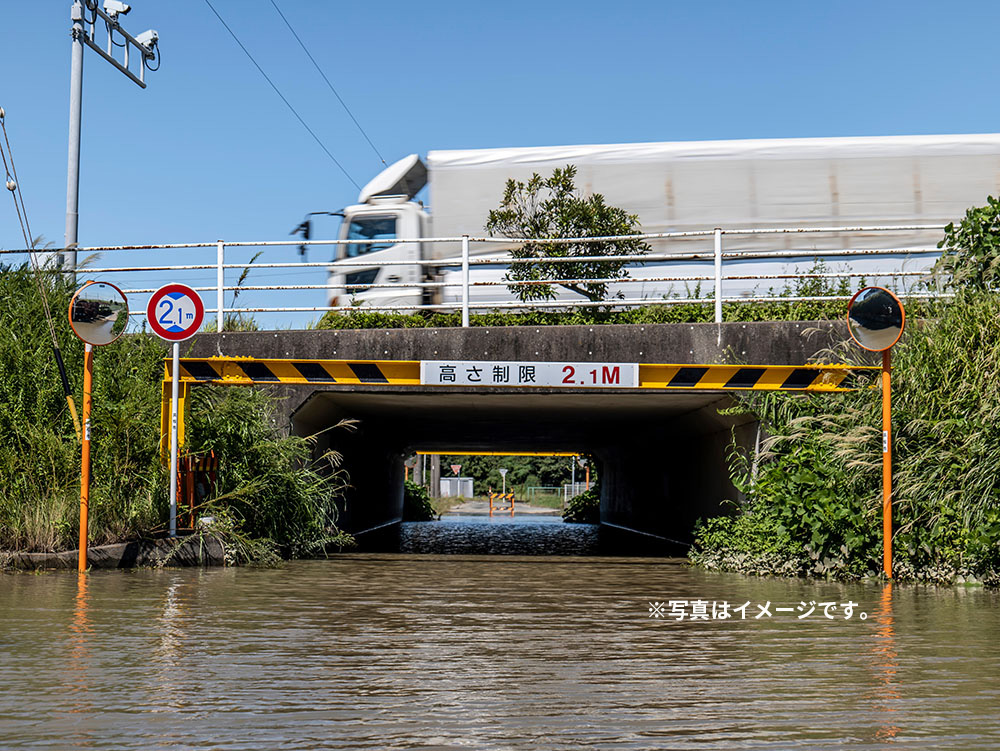 Takaoka City: Underpass flooding monitoring solution
Road Maintenance Division, Urban Development Department, Takaoka City; TAKAOKA CABLE NETWORK CO., LTD.; and SANGIKYO CORPORATION Enhanced Video Management SystemAG20
-
 Toshima City: Disaster preparedness and crisis management camera solution
Disaster Prevention Crisis Management Section, General Affairs Department, Toshima City Enhanced Video Management SystemAG20




Contact usProduct inquiries and documents
We can help you choose products and put together a package for your application. Consultations are free.