How IoT routers help with the challenges of monitoring EV charging stations
Jan 18, 2024
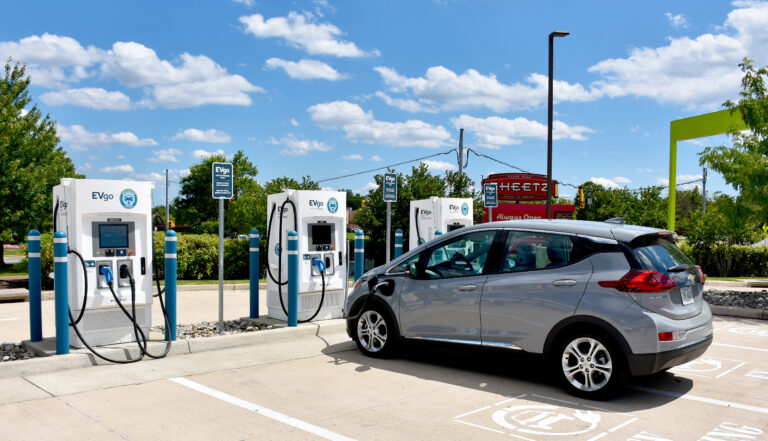
Electric vehicles (EVs) are gradually becoming more common as part of the move toward carbon neutrality, and EV charging stations and the EV chargers installed at them are becoming important. When this equipment, which will be key infrastructure in the future, is installed outdoors, monitoring the operation of EV chargers raises several challenges. This article explains these challenges and how IoT routers can address them.
Recommended products

The current state of EV charging stations
As of March 2022, there were just under 30,000 public EV chargers in Japan, of which just under 8,300 were quick chargers. Quick charging is regarded as important social infrastructure, and chargers are being installed mainly at car dealerships and convenience stores, where installation is relatively easy, and at roadside rest areas (michi-no-eki) and expressway service areas, where the need is high.
The government aims to install 30,000 public quick chargers and 120,000 standard chargers by 2030. Behind this is the “Green Growth Strategy Through Achieving Carbon Neutrality in 2050,” formulated by the Ministry of Economy, Trade and Industry (METI) in December 2020. It aims for carbon neutrality across the entire life cycle of automobiles by 2050 through initiatives such as electrification in the automobile and storage battery industries and changes in how cars are used. The government has also announced that electrified vehicles (EVs) will make up 100% of new passenger car sales by 2035.


EV charging stations are essential for the spread of EVs, but simply installing them is not enough. You also need to plan for equipment monitoring for operation and management. The challenges in monitoring the operation of EV chargers are described below.
Challenges in monitoring EV charger operation
There are two challenges in monitoring the operation of EV chargers.
Responding to failures manually is difficult
The first challenge is that when EV chargers are installed at many locations, responding to failures manually is difficult. If staff are sent to each location to check the equipment one by one and carry out recovery work, travel time and labor costs add up. Considering these costs, some cases call for a system that can monitor operation remotely.
EV chargers often run outdoors for long periods
The second challenge is that EV chargers often run outdoors for long periods. Most EV charging stations are outdoors, so remote monitoring equipment installed with them faces a higher risk of failures and problems than indoor equipment, caused by temperature rise from direct sunlight, moisture from condensation, induced lightning, and momentary power interruptions.
In remote areas, the connection may also be unstable, and IoT gateways or routers without stable communication may run into trouble.
To address these challenges, you need a way to manage many facilities remotely, and a rugged system that runs reliably without trouble in harsh outdoor environments and keeps a stable internet connection even in remote areas.
Solutions to EV charger monitoring challenges
To solve the challenges above, IoT routers and gateways designed for industrial use are effective. Products with high environmental durability, ruggedness such as protection against momentary power interruptions, and full remote monitoring functions for efficient maintenance and operation are preferable.
We also recommend products with multiple SIMs and automatic failover for redundant mobile connections, so that if one mobile carrier’s network goes down, the device switches automatically to another carrier and restores communication. With an IoT gateway, which has higher specifications than an IoT router, you can also run custom applications to further improve operation and management, for example by optimizing energy resources.
Benefits of using IoT routers
Here are the benefits of using IoT routers to monitor EV charger operation.
Unified operation of multiple devices:
Integration with a cloud-based device management system reduces many kinds of operational work.
Examples: Device health monitoring
Automatic initial setup of IoT routers
Configuration transfer when replacing a failed device
Remote monitoring and bulk updates of firmware and configuration, and more
The next section introduces a case where IoT routers and IoT gateways are used.
Case study: Using IoT routers and IoT gateways
Below is the case of i GRID SOLUTIONS Inc. as an example of using IoT routers and IoT gateways.
i GRID SOLUTIONS Inc. provides R.E.A.L. New Energy Platform®, an energy management platform for companies that install solar panels for their own use. To deal with unexpected surplus power or power shortages, AI predicts the balance of power supply and demand and controls generation and discharge.
R.E.A.L. New Energy Platform® manages the generation equipment and storage batteries installed at business sites, grid power, and even the charging and discharging of EVs used by the business, all together, to optimize power use. It manages the amount of power stored in batteries and EVs and constantly monitors the power demand of the business site. This data is collected in a system built in the cloud, where AI makes decisions and controls the charging and discharging of power equipment and adjusts the power consumption of site equipment.
An IoT gateway was introduced into this system. The control units for solar power and storage batteries, and sensors such as pyranometers, were connected to the edge gateway through interface converters. An application running on the edge gateway sends on-site measurement data to the cloud and passes control signals from the cloud to on-site equipment. As a result, the LTE router and server functions were combined in one device, creating a low-cost, high-quality system. Because the gateway supports a wide operating temperature range, it can also be installed outdoors.
amnimo IoT routers for monitoring EV charging station equipment
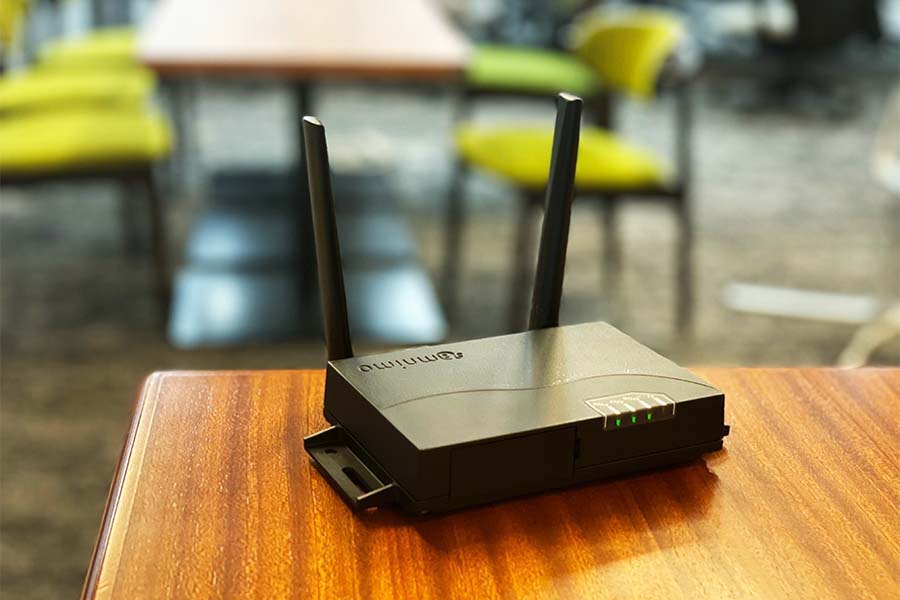
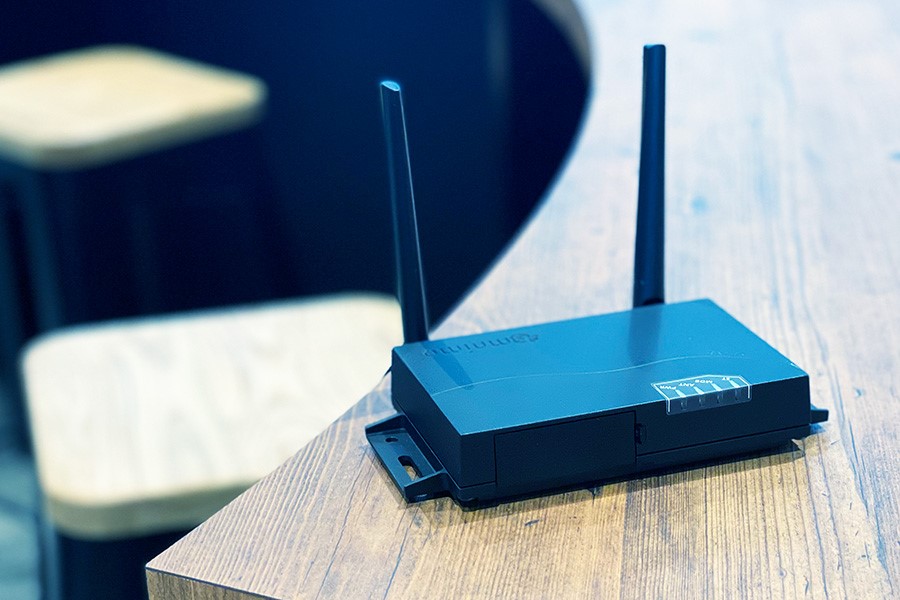
amnimo’s Compact Router series includes models suited to many applications, both indoors and outdoors. For example, the Compact Router with Wireless LAN (Indoor) AC15 is a highly reliable compact router with a Cat.4 LTE module, wireless LAN, two LAN ports, dual SIM support, and protection against momentary power interruptions, and it operates from -20°C to 60°C.
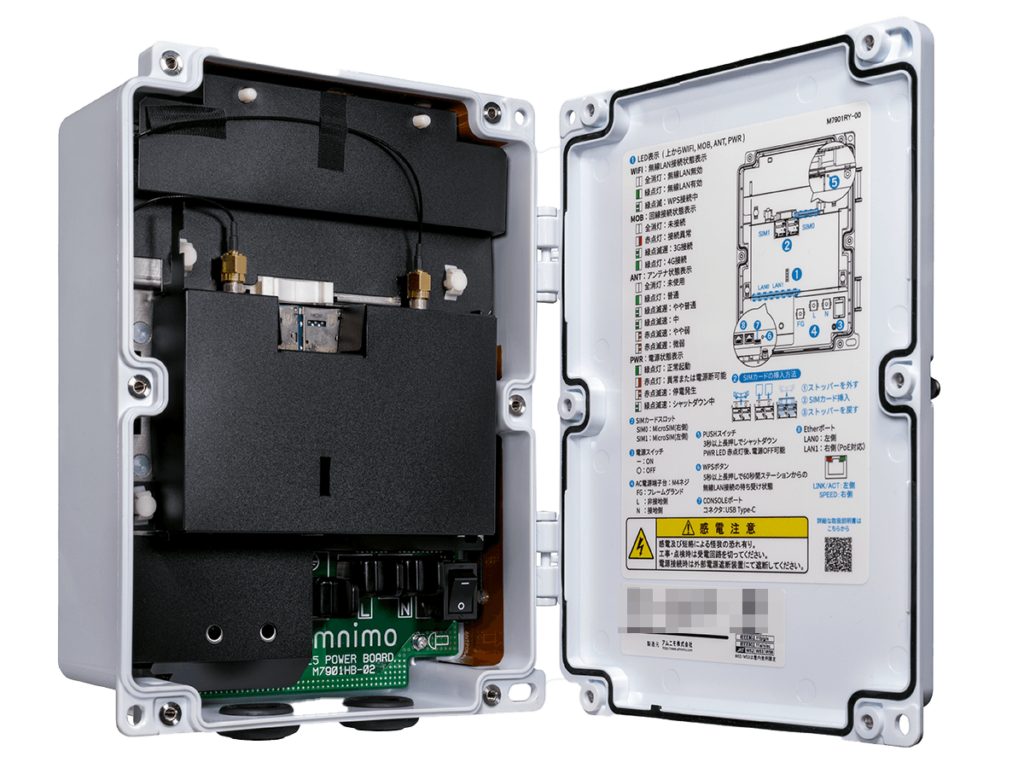
The outdoor model AC25 also has wireless LAN like the AC15, plus one PoE port. The power supply and LTE antenna are housed in one box, and if the external power is momentarily interrupted, its protection function keeps it running for 10 seconds or more, so it can be used where the power supply is unstable. It is dust- and water-resistant, its operating temperature range is -20°C to 60°C with direct sunlight taken into account, and it has an SPD (surge protective device) against induced lightning. It is rugged enough to run reliably in harsh outdoor environments.
The documents below describe the Compact Router with Wireless LAN AC15 and AC25, which address the EV charging station monitoring challenges described in this article.
Take a look if you are interested.
Recommended products
Products related to this article
Contact usProduct inquiries and documents
We can help you choose products and put together a package for your application. Consultations are free.