What is a license plate recognition system?
Mar 23, 2023
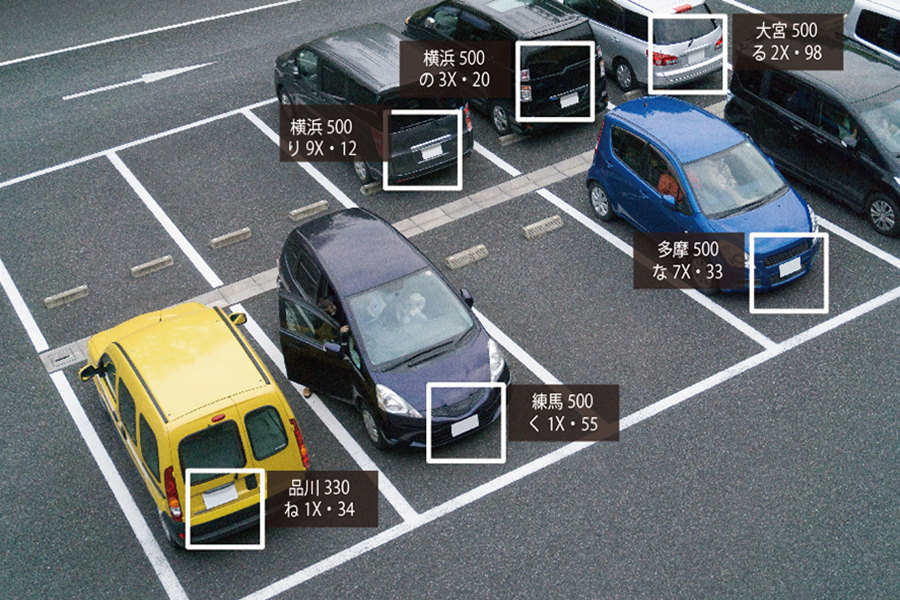
How will artificial intelligence (AI) change our lives? This article looks at license plate recognition, which uses deep learning technology. Have you ever been surprised when staff at a car dealership greeted you by name as soon as you arrived? In fact, a network camera at the parking lot entrance reads the car’s license plate, and the plate number is linked to customer information so that sales staff can serve each customer individually. License plate recognition is widely used, for example to manage parking lot entry and exit, monitor traffic, and watch for suspicious or stolen vehicles. This article explains license plate recognition in detail: an overview, the data processing flow, challenges and solutions, examples, and technologies.
Overview of license plate recognition and the data processing flow
License plate recognition first reads only the license plate area from an image of a vehicle that includes the plate. It then cuts out the character areas from the plate image. Character recognition on each area then identifies the vehicle. By linking with a customer management system and loading the recognition results, the system can also display customer information.

Points to consider when introducing a system
License plate recognition identifies individuals from the license plate alone, so it requires high accuracy. It is used outdoors, so you need to adjust the camera position, check the size of the plate and characters in the image in advance, and arrange the lighting to capture high-contrast images. However, at night or on rainy days, very low light or halation from reflected street lights can sharply reduce recognition accuracy. Direct sunlight, backlight, and dirty license plates also reduce accuracy.
How to choose a license plate recognition system
Fast response and high recognition accuracy
A high-performance recognition engine that can recognize vehicles entering at sharp angles brings the recognition rate very close to 100%. It is also important that the system supports large trucks and buses with different plate sizes and plates with designs or letters, and that it recognizes images quickly.
Recognition of moving vehicles
Depending on the use case, check the maximum vehicle speed at which plates can be recognized.
Can it recognize plates at dusk and at night?
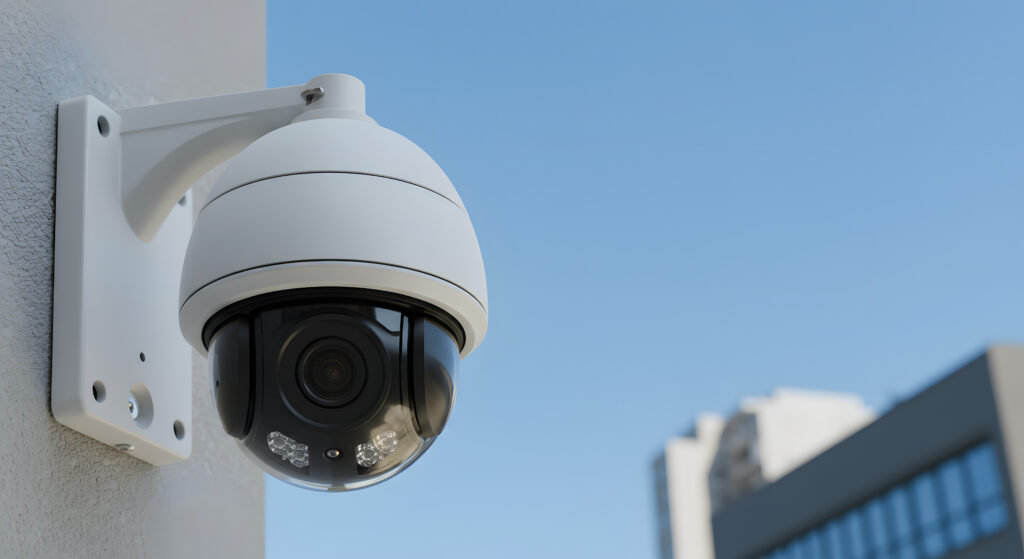
A camera with a built-in infrared illuminator can recognize plates accurately even in dark conditions such as at night.
Where can it be used?
Here are some use cases where license plate recognition is actually used. Use them as a reference when you consider introducing a system.
Automating parking lot entry and exit
A system that automatically detects and records license plates shortens entry and exit times and reduces congestion at the gates. The plate is photographed as the car passes the gate. At the management center, the plate number is entered into a server and sent to the pre-payment machine. When the driver pays in advance and leaves, the gate opens automatically through this sequence. You can also compare current entry and exit counts with past data.
Recently, a new type of paid parking called “Smart Park” has also appeared, with no entry or exit gates and no parking tickets. In a Smart Park, cameras in the parking lot photograph license plates, and the data is used to manage usage. Parking fees are paid at a payment machine at the store entrance. Drivers enter their plate number into the machine, pay, and leave. Because payment is self-reported, drivers can leave without paying. However, the system is designed so that unpaid fees are charged on the next visit. For drivers who abuse the system, the plate number is registered, and the store is notified by email on their next visit. Stores are also notified by email about vehicles of persons of concern, such as repeat shoplifters. One store that adopted Smart Park reportedly saw the number of shoplifted items fall by nearly 20%.
Recording and monitoring vehicles entering factories and logistics centers
Factories and construction sites use license plate recognition for security purposes, such as managing vehicle entry and exit at the gate and making guard work more efficient, and to reduce congestion at reception. Recognizing plate numbers at the entrance makes it easy to record entry and exit history automatically and to manage designated contractors. You can strengthen security by tightening checks at the entrance or by using it with a gate to prevent unauthorized vehicles from entering. If something happens, you can search by date, time, registration status, and plate number to help with crime prevention.
Improving customer service by linking plate numbers with customer information
By linking plate numbers with customer information, you can offer each customer suitable service when they arrive. It also helps strengthen customer engagement and win new customers. The system matches customer data with plate numbers in real time and displays the data for the vehicle. In some cases, it can work with a warning light to notify the customer’s sales representative in advance, which can greatly improve customer satisfaction.
More efficient traffic surveys
Traffic surveys are carried out to reduce congestion on expressways and ordinary roads and for marketing when opening new stores. AI analysis of video of vehicles traveling at high speed makes it easy to count and total traffic and to analyze it in detail by vehicle type and by commercial or private use. This removes the need for long hours of manual counting and makes survey work much more efficient.
amnimo’s work on license plate recognition
License plate recognition trial
amnimo carried out an in-house trial of license plate recognition with the following setup.
1. Video from an IP camera is fed into a license plate recognition engine through the video management system (VMS) on the edge gateway.
2. Recognition results are checked on the VMS.
– You can see at a glance when and with which camera a plate was recognized.
– The VMS’s filter functions can also be used.
3. Recognition results can also be checked on amnimo cloud (data linked through a web API).

Developing a gateway with an AI chip
As a derivative of our edge gateway (Japanese), already on the market, amnimo is developing an AI edge gateway. Its main features are as follows.
- A dedicated AI processor built into the device enables edge AI (Japanese)
- Like the edge gateway, it includes a VMS (video management system) and DMS (device management system) that can work together
- Supports ONNX, a common AI model format
- Designed to reduce power consumption and heat during AI processing
(Reference) Examples of technologies used to build the system
When building a license plate recognition system, it is important to choose libraries that are reliable and that you are familiar with. Reliable languages receive regular updates and good support when problems occur. Here are some examples of the technologies.
- License plate area detection with the TensorFlow Object Detection API, a framework for object detection
- SSD (Single Shot Detection) as the object detection algorithm and Inception v2 as the neural network
- CRNN (Convolutional Recurrent Neural Network) for character recognition
- A Python script that synthesizes license plate images to provide a large amount of training data
Summary
This article explained the data processing flow, challenges and solutions, examples, and technologies of license plate recognition. Rapid progress in deep learning is bringing it into practical use in many fields. AI will bring change to every part of society, including daily life, manufacturing, and education. Use this as an opportunity to imagine a better society in the future.

Contact usProduct inquiries and documents
We can help you choose products and put together a package for your application. Consultations are free.