How does solar power work? A clear explanation
Mar 23, 2023
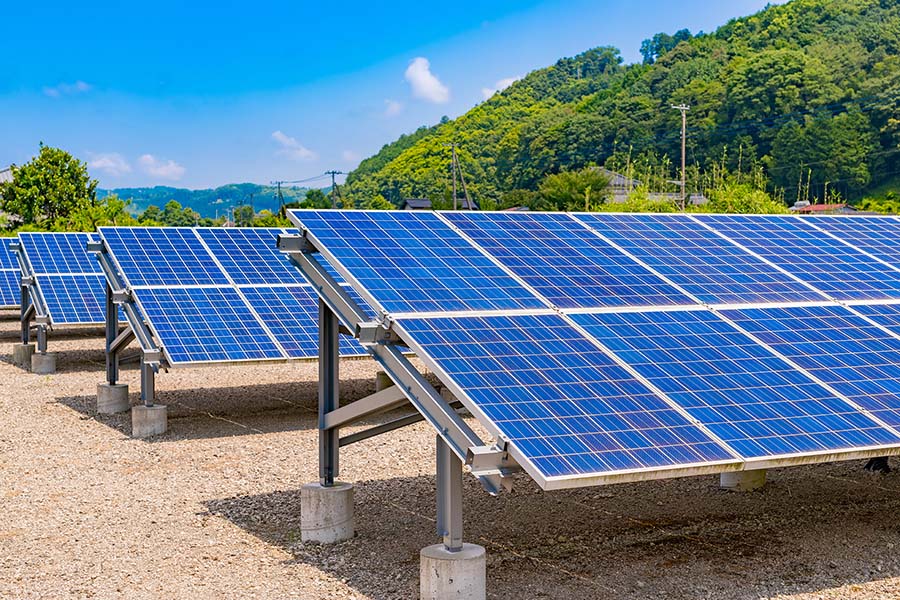
The FIT*1 scheme (feed-in tariff scheme), launched in July 2012, led to a rapid increase in renewable energy power generation facilities. A new FIP scheme (*2) was then set to be added from April 2022. Among renewable energy sources, solar power in particular is expected to grow at an accelerating pace, for both residential (under 10 kW) and industrial (10 kW or more) systems, as electric vehicles (EVs) spread and new business models combine solar with storage batteries. A solar power system consists mainly of three parts: panels, a power conditioner, and a mounting frame. This article explains the basics of solar power, each device in the system (solar panels, power conditioners, breakers, and watt-hour meters), and the challenges of solar power and how to address them.
*1 Short for “feed-in tariff.” A scheme in which the government guarantees that power companies will buy electricity generated from renewable energy at a fixed price for a fixed period.
*2 Short for “feed-in premium.” A scheme in which renewable energy producers that sell their electricity on the wholesale power market or through bilateral contracts receive a premium equal to the difference between the reference price (FIP price) and the market price.
How solar power works
A system that converts the electricity generated from light by solar panels into a usable form, for use at home or for sale to a power company as a business, needs the following devices.
- Solar panels
- Junction box
- Power conditioner
- Breaker (earth leakage circuit breaker)
The system combines these devices.
Electricity from the solar panels is combined in the junction box and converted to AC at a constant voltage by the power conditioner. Under the surplus power purchase scheme, the generator uses the power first and the power company buys the surplus. Under the full purchase scheme, the power company buys all the power generated. Note that the FIT (feed-in tariff) scheme changed in 2020. Under the previous system, solar power of 10 kW or more could choose either surplus purchase or full purchase. However, solar facilities of 10 kW to under 50 kW certified in 2020 or later, like systems under 10 kW, can now use only surplus purchase (with at least 30% of generation used for self-consumption).
For single-phase 100 V, the power conditioner output is actually set to 107 V. The standard for commercial power is 101±6 V, that is, 95 to 107 V. Electricity flows from higher voltage to lower voltage, so a higher output voltage lets power flow into the transmission line. This is called reverse power flow.
The problem arises when the transmission line voltage rises above 107 V. This happens where there are many solar power facilities nearby. When they all run at full output and too much electricity flows into the line, the voltage rises above 107 V. The power conditioner’s voltage control function then kicks in and limits output.
From generation to transmission: a simple overview

What is a solar panel?
Solar panels are the core of the system, and they are now often seen on the roofs of houses. A solar panel is a group (module) of individual solar cells, and a group of modules is called an array. When light strikes silicon, a semiconductor, electrons in the semiconductor move and create a potential difference, which generates electricity. Converting light energy into electricity causes no physical change in the semiconductor itself, so panels can keep generating power almost indefinitely.

Types of solar panels
Panels fall into two broad types: silicon-based (monocrystalline, polycrystalline, amorphous, and HIT silicon) and compound-based. The advantages and disadvantages of each are listed below. Monocrystalline and polycrystalline panels are the most common, but they are expensive, so work is under way to develop non-silicon materials and lower prices. CIS/CIGS in particular is expected to see the greatest market growth.
Silicon-based
Monocrystalline silicon
Structure: Each cell is made from a single crystal.
Advantages: The first type developed, used for many years. High generation efficiency.
Disadvantages: Expensive. Conversion efficiency drops significantly at high temperatures.
Polycrystalline silicon
Structure: Cells are formed on a substrate made of many crystals.
Advantages: The second-highest generation efficiency after monocrystalline. Less expensive than monocrystalline.
Disadvantages: The second most expensive after monocrystalline. Conversion efficiency drops significantly at high temperatures.
Amorphous (non-crystalline) silicon
Structure: Silicon is formed into an extremely thin film on a glass or metal sheet.
Advantages: Little loss of output at high temperatures. Can be made in large sizes and installed on curved surfaces.
Disadvantages: Lower conversion efficiency than monocrystalline and polycrystalline.
HIT silicon (hybrid)
Structure: Combines monocrystalline and amorphous silicon.
Advantages: Little loss of output at high temperatures.
Disadvantages: Expensive.
Compound-based
CIS/CIGS
Structure: CIS is made from a compound semiconductor of copper, indium, and selenium. CIGS adds gallium to these three elements.
Advantages: Handles heat well. Low manufacturing cost. Output drops little in shade. Expected to be used more in the future.
Disadvantages: Lower conversion efficiency than crystalline silicon.
CdTe
Structure: Made from a compound semiconductor of cadmium and tellurium.
Advantages: Very good cost performance and generation efficiency.
Disadvantages: Contains cadmium, a hazardous substance. (No company manufactures it in Japan.)
Annual output of solar panels
Output varies by region with weather and sunshine hours, but on average it is about 1,000 kWh to 1,200 kWh per year per kW.
Lifespan of solar panels
Some deterioration over time is unavoidable, but panels are generally said to last a long time (about 30 years). Manufacturers’ technology has improved greatly, and there is now little difference in the performance of the panels themselves. From now on, the key question will be how much of the original output panels can keep after 30 or 50 years. The standard for panel strength is JIS C 8990, and panels are designed to withstand a wind pressure load of 2,400 Pa (equivalent to a wind speed of 62 m/s).
However, watch out for a phenomenon called a hot spot. For example, if fallen leaves cover part of a panel and that part stops generating completely, it becomes a resistor. When electricity generated by other cells flows through it, it heats up like the nichrome wire in an electric heater. This heated area is the hot spot, and it can break the wiring inside the panel. To prevent this, bypass diodes are installed, usually two or three per panel, one for each block.
What is a power conditioner?
Solar panels generate DC power, which cannot be sold as is. It must be converted to AC, the same as the power from power companies. The device that converts DC to AC is called a power conditioner or an inverter. DC flows at a constant voltage, while AC alternates between positive and negative. One trip from positive through negative and back to positive is called a cycle. The number of cycles per second is the frequency, measured in hertz (Hz). In Japan, the area west of the Fuji River uses 60 Hz and the area east uses 50 Hz.
A power conditioner for selling solar power does not just convert DC to AC. It also matches the voltage and frequency to the quality of the power company’s electricity. This is called the synchronization function. Power company electricity is a blend of power from multiple wind, thermal, hydro, and other plants, and each plant runs in synchronization. The power conditioner must also run in synchronization in the same way. Besides synchronization, it has various built-in protection functions in case of grid faults, all controlled by a microcontroller. Stopping safely during a power outage is one example. When generation exceeds consumption, voltage rises, and the power conditioner also has a function to control it to a set voltage (107 V single-phase, 222 V three-phase).

Power conditioner efficiency
The ratio at which a power conditioner converts DC input to AC is called the conversion efficiency. Most products are around 95%, and it is easy to assume that a higher figure such as 96% or 97% is better. However, you cannot compare efficiency on this figure alone. What determines a power conditioner’s efficiency is how well it can draw out the full capability of the solar panels. This function is called maximum power point tracking.
About maximum power point tracking
Let’s explain the relationship between current and voltage in a solar module with a simulated graph. At low voltage, the current stays constant at its maximum. At high voltage, current flows less easily. This comes from the nature of solar panels, which were originally intended to charge batteries. The point where the panel’s output is greatest, a point on the curved part of the graph, is called the maximum power point. It is the point where the product of current and voltage is greatest. The power conditioner finds this point and sets the panel’s input voltage. In other words, the power conditioner, not the panel, decides the DC input voltage.
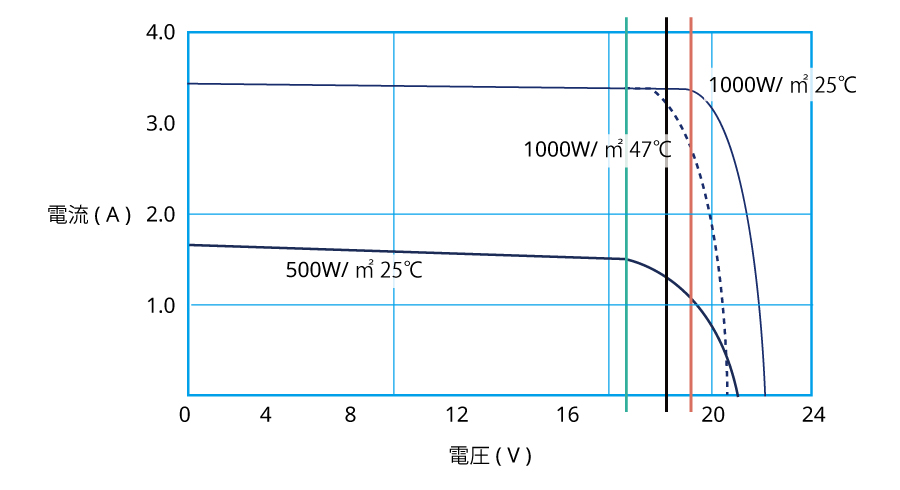
Solar panel voltage also changes with temperature. For example, the solid black line is at 25°C and the dotted line is at 47°C. The power conditioner controls the voltage to follow these temperature changes as well. Efficiency therefore depends on the microcontroller program that controls this DC voltage. Because power conditioner efficiency depends largely on the quality of the program, you cannot tell without comparing actual generation.
Breakers (distribution board)
A circuit breaker cuts off the circuit when current above a set value flows. An earth leakage circuit breaker (ELB), on the other hand, detects leaking current and cuts off the circuit. Both prevent damage to equipment in abnormal situations.
Watt-hour meters
Whether you sell or buy power, the charge is calculated from the amount of energy (power over time). The meter that measures this energy is called a watt-hour meter. It totals and displays how much power has been used or generated. There are analog and digital meters. To measure currents above 120 A, the meter cannot be placed directly in the circuit, so measurement goes through a device called a CT (current transformer). To prevent fraud, these meters are supplied by the power company. Who pays for the meter and its installation differs by power company, and the rules may change, so check in advance.
Summary
This article covered the basics of solar power and the details of the devices that play important roles in a solar power system, starting with the power conditioner. As prices fall, demand for self-consumption is rising, and various business models have appeared, such as combining solar with storage batteries or electric vehicles to increase self-consumption.
Finally, oil, coal, and natural gas all formed over long periods from ancient plants that grew with sunlight. Here is a science that turns the light energy of the sun, the source of all the energy on Earth, into electrical energy with a simple panel: light striking a sheet of glass only a few millimeters thick. New efforts in nature and science for the future of the planet and people are starting right now.
amnimo’s work on the operational challenges of solar power
Monitoring solar power remotely
In solar power, monitoring systems that can be managed remotely are drawing attention. They collect data such as daily generation, solar radiation, and battery charge, so that facilities can be run with minimum loss of power sales. amnimo provides products and services that keep systems running stably even in harsh outdoor locations. If you are planning a new solar power facility or residential solar system, or if regular maintenance, operation, and inspection are a concern, consider our products and services.
1. We provide an edge gateway (Japanese) that combines the functions needed for solar power monitoring, such as data storage, an LTE router, a hub, communication converters, and a server, in one device. It costs less and is more stable than a system built by gathering the necessary devices separately.
2. High environmental durability keeps it running stably even in harsh outdoor environments. A power backup mechanism built into the device provides protection against momentary power interruptions (Japanese).
3. You can perform device health monitoring (Japanese) of equipment and devices remotely, which makes maintenance more efficient.
4. You can retrieve operating logs from generation equipment remotely. If equipment stops, you can use this information to carry out recovery work efficiently.
5. The gateway runs a Linux OS, so you can run custom applications on Ubuntu and build a system tailored to your needs.
Contact usProduct inquiries and documents
We can help you choose products and put together a package for your application. Consultations are free.