
Analyzing AI foot traffic and demographic data to revitalize a local shopping street

- Customer
- Professor Yuji Yamaguchi and Professor Sho Kawasaki, J. F. Oberlin University; Kazuyoshi Takeda, Shin-Okubo Shopping Street Promotion Association
- Industry
- Universities and education
- Products used
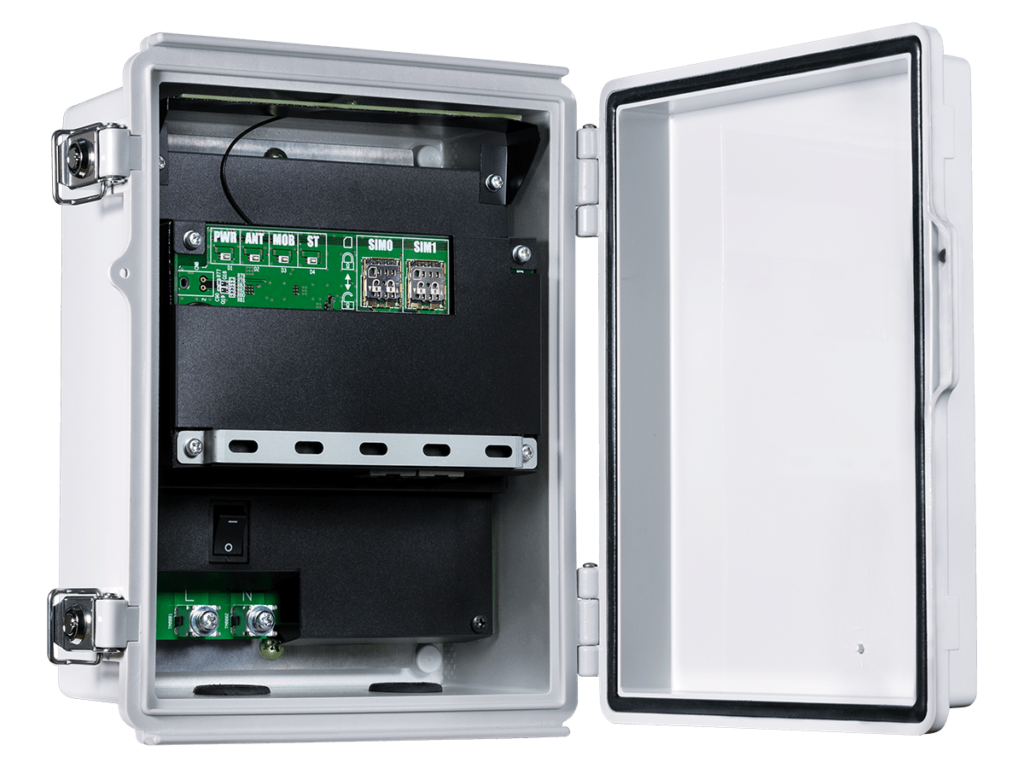
- IoT Router (Outdoor) AR20
“Because the system runs reliably, we can collect plenty of valuable data.”
— Professor Yuji Yamaguchi and Professor Sho Kawasaki, J. F. Oberlin University; Kazuyoshi Takeda, Shin-Okubo Shopping Street Promotion Association —
Industry
Universities and educational institutions
Products
IoT Router (Outdoor) AR20
Recommended products
Application
AI foot traffic measurement for “local community revitalization”
Challenges
- Large equipment can limit where it can be installed
- With many installation constraints, it is hard to get accurate data
- Periods without data reduce the value of the data
Results
- Compact equipment can be installed flexibly at locations suited to measurement
- Peace of mind with equipment that is highly durable in both hardware and software.
- Reliable system operation makes it possible to collect plenty of valuable data.
Overview: Hands-on research with a local shopping street
The College of Business Management at J. F. Oberlin University teaches business administration and commerce. It places particular emphasis on hands-on education and carries out many research projects and initiatives with companies and local communities. Because of this university policy, it also works to build relationships with the local community. The Shin-Okubo Shopping Street Promotion Association was especially eager to take on new initiatives, so the college is carrying out various research projects that can benefit the community with the association’s cooperation. The AI camera foot traffic and demographic measurement project introduced here was also made possible with the association’s cooperation.
The project grew out of a view that, as data science and AI draw attention, humanities and social science students should also actively learn scientific thinking and how to use data. In 2022, the project was selected by the Ministry of Education, Culture, Sports, Science and Technology (MEXT) under its university reform subsidy program “Developing highly skilled professionals to lead industrial DX by combining digital technology with specialized fields,” as a “program to develop personnel who promote DX in small and medium-sized tertiary industry businesses through advanced use of visitor, store, and other data.” It is now attracting attention.
The Shin-Okubo Shopping Street Promotion Association also wanted to use data to promote the appeal of the shopping street to people outside. With these goals in common, the project to collect and use foot traffic and demographic data started in 2019.
Goal: More efficient research and better results through AI camera foot traffic and demographic measurement
Measuring foot traffic and demographics on the shopping street with AI cameras
This project uses FieldAnalyst, a person image analysis system from NEC Solution Innovators, Ltd., to measure foot traffic and demographics. AI analyzes video data to obtain information such as people entering and leaving (people counting), times, and each person’s gender and age. The system does not record images and saves only the measured values, so the measurement protects privacy. In this case, the AI software runs on an IP camera. amnimo’s IoT router supplies PoE power to the IP camera and sends the video data and AI processing results over a mobile network. The data is stored in the cloud and can be viewed on a PC or other device.

More effective research through efficient data collection
In social science research, data is usually collected through questionnaires and interviews. These surveys can capture each person’s situation and background in detail, but the sample size is small. With foot traffic cameras installed, a large amount of data accumulates naturally, which was a major advantage of introducing the system. As data accumulates in various forms and grows in volume, the chances of valuable analysis increase. The more data that is accumulated in real time, the more valuable the data and analysis become.
Students actually analyze the accumulated data and learn by working with it. The university is also working to share this data with store owners, people from the shopping street, and wholesalers, not only students, to lead to further learning.
Creating attractions so that young people enjoy the shopping street
“The truth is, we had done almost no research on visitors to the shopping street until now,” says Mr. Takeda, Secretary General of the Shin-Okubo Shopping Street Promotion Association. In 2019, before the foot traffic cameras were installed, J. F. Oberlin University students conducted a questionnaire survey to compare with the data the cameras would measure in the future. Nearly 1,000 people responded, and the survey showed differences between weekdays and weekends and the share of repeat visitors. The association received information such as station passenger numbers from the railway company, but it did not know about the flow of people or the repeat rate. This made it realize again how useful the data is.
The Shin-Okubo shopping street has also seen its customer demographics change greatly over the past 20 years. When Korean dramas such as Winter Sonata were popular, visitors were relatively older, but with the popularity of K-pop, the age range dropped sharply. In recent years in particular, more Korean cosmetics stores have opened, and it is now a town centered on young people. The association therefore believes it needs attractions that young people will enjoy. Using this data, it wants to show people outside what kinds of visitors come to the Shin-Okubo shopping street and how many, and to increase attractions and investment so that visitors can enjoy the area.
Results: Protecting the value of data by collecting it reliably
amnimo’s IoT Router (Outdoor) was used in this foot traffic measurement system. Here are some of the advantages of amnimo’s IoT router.
1. Compact equipment can be installed flexibly at locations suited to measurement
“The hardest part of installing outdoors is securing an installation location,” says Mr. Hamasaki of NEC Solution Innovators, who built the foot traffic measurement system. In this project, two things helped: the Shin-Okubo Shopping Street Promotion Association provided suitable locations, and amnimo’s compact, outdoor-ready router was used.
Previously, to run a system reliably outdoors, the equipment had to be mounted in a large box with temperature control and other functions, and a place had to be found for it. Even when a candidate location was found, it sometimes could not be used because of strength issues, and in some cases it took more than six months to find a location.
Especially when using AI to measure demographics, capturing people properly is very important for accuracy. In a town, there are only a few places where people can be captured properly, so the camera is sometimes placed far away and angled so that people face it as directly as possible. However, low resolution or obstacles often prevent good images.
So a system that can be installed flexibly almost anywhere is very important for quickly introducing a more accurate system. I think this was possible only because of amnimo’s compact, outdoor-ready IoT router.
2. Peace of mind with equipment that is highly durable in both hardware and software
Despite its compact design, amnimo’s IoT router has high environmental durability that withstands continuous outdoor operation. Together with strong system security, it is highly durable in both hardware and software, so they can use it with confidence.
3. Reliable system operation makes it possible to collect plenty of valuable data
“It is extremely important that the system runs reliably,” points out Professor Kawasaki of J. F. Oberlin University. As a data analysis expert, the biggest problem for him is having periods when no data can be collected. Missing data sharply reduces the value of the data. Collecting data reliably may seem obvious, but it is very important.

Outlook: Analyzing data in combination to revitalize the shopping street
The key is analysis combined with other data
In analysis, what matters is combining information. To get useful results, the foot traffic and demographic data collected here needs to be combined with something else.
Foot traffic data alone can reveal changes between weekends and weekdays or by time of day, but it is not enough to find out what those changes are related to. The more types of data you have, such as weather data, station passenger data, and event information, the more valuable things you can find while “exploring” the data. Currently, the team analyzes the data in combination with weather and demographic information. Going forward, with the cooperation of people on the shopping street, the team wants to combine store information and other data with the foot traffic and demographic data, keep “exploring the data,” and find useful results.
The team also hopes that AI will be able to measure more types of data, beyond the age and gender measured now. For example, counting people carrying rolling suitcases might make it possible to estimate the number of tourists visiting from abroad. Professor Yamaguchi’s research has also shown that the distance between two people walking together changes depending on their relationship. Couples tend to walk closest, followed by friends, while work colleagues and, surprisingly, married couples tend to walk farther apart. It could be interesting to estimate the relationships between visitors by measuring this distance. As more information related not only to faces but also to behavior becomes available, the range of possible combinations will grow even wider.
Using the analysis to promote the town as a more attractive place
To make use of the analysis on the shopping street, the team believes it is important to publish information externally. Publishing foot traffic data will make more people interested in the town. If the data becomes a basis for decisions on renovations and investment, it will help revitalize the town. For example, product launches and events are effective for revitalizing a shopping street. To attract such events, it is important to publish what kinds of people gather, how many, and even why they gather there. This kind of promotion can also be expected to attract investment. To liven up the shopping street, support from outside is essential, and it is important to get more people interested.
Expanding to other shopping streets
The team also wants to extend this kind of initiative to other shopping streets. In fact, with the cooperation of the Shin-Okubo Shopping Street Promotion Association, J. F. Oberlin University is also measuring foot traffic with cameras in Harajuku. There must be many shopping streets, including those in regional areas, with similar challenges. By carrying out AI camera foot traffic measurement not just in one place but on other shopping streets too, the team expects greater combined value, including comparisons between shopping streets.
Building students’ skills through hands-on education
The data collected here can be used not only to revitalize the shopping street but also for education. The university wants students to communicate actively with people from companies through hands-on exercises like this, and to apply what they learn in their future working lives. Some students are actually working on starting businesses based on the information from the foot traffic cameras. The university hopes students will not only analyze data but also propose specific improvements, and extend them not only to the Shin-Okubo shopping street but also to other shopping streets. Once even one case shows results, it will spread naturally, and the university believes it will attract interest not only from the local community and shopping streets but also from companies.


Products used in this case study
Related case studies
-
 Revitalizing the whole town with AI foot traffic measurement
Masahiko Yamada, Director for Digital Promotion, Takayama City AR20
-
 Field trial report: counting visitors at a trade show booth with the amnimo Portable AB11
AB11
-
 Takaoka City: Underpass flooding monitoring solution
Road Maintenance Division, Urban Development Department, Takaoka City; TAKAOKA CABLE NETWORK CO., LTD.; and SANGIKYO CORPORATION Enhanced Video Management SystemAG20




Contact usProduct inquiries and documents
We can help you choose products and put together a package for your application. Consultations are free.